Ormiston Gorge – North MacDonnell Range National Park 

Not knowing if we would ever be coming back to the Red Center in Northern Territory Australia, we decided on one last very highly recommended area to visit — the West MacDonnell Ranges. This would be an approximately 550 K drive to the identified campground. Without a 4WD vehicle necessitated going back to Alice Springs and heading west to our destination which was Ellery Creek Big Hole Campground in Tjoritja /West MacDonnell Range National Park. It sounded especially inviting because it had one of the permanent water holes which we hoped to swim in. We anticipated getting there before dark, but barely. Since we had already seen the miles and miles of the stark and unremarkable bushland, we kept a good speed up and made decent time.

Since camping was first come first served, we had to consider alternatives as well since we would be arriving late in the day. We arrived there around sunset time and we were relieved to find 3 open sites to choose from. They all basically backed up to a large communal field and cook area. We were still setting our tents up on the fine red dirt, but had a bit more “privacy” vegetation on the site. It was a race to get camp set by dark, but since it was warm and there was no predicted rain in sight, we opted not to use the rain fly. It was a good bet because we learned that there had been no rain in this area since January. Luke was really hesitant because he was worried about privacy but soon got over it. Reclaimed water was used for flush toilets but there was no fresh water available for drinking or cooking. We were relying on the communal stoves to boil water as our gas canister was low but those metal plates do not transfer heat very readily to our cooking pots. It even takes quite a bit of time to cook anything directly on the grill. After about a half hour of trying to get the pasta pot boiling a generous fellow camper loaned us his gas camp stove to finish cooking the meal (in the dark of course by headlamp). But it always feels like a good challenge to accomplish the goal even under a bit of duress. The night was uneventful, no loud family’s nearby and we awoke early to break camp and head out for the days hike and then on to Alice Springs. We did not get to the water hole but thought it would be an option on the way back.

In the morning we headed first to Glen Helen Resort to buy water, a must have commodity for the Ormiston Gorge walk. I guess we had not really believed that there would not water or at least we would have a way to boil it. Glen Helen was an interesting “resort” of sorts near near Ormiston Gorge and seemed typical of Australian outback accommodations. It is rustic, with lodge rooms, stockman’s quarters, fixed tents and a range of caravan and camping sites on its website. I might better describe it as an aging old motel with rooms, shared rooms with metal bunk beds, platform tents and an unshaded lawn for camping and caravan parking. But they did have cold Coke Zero and cold bottled water-and that fulfilled our basic need!

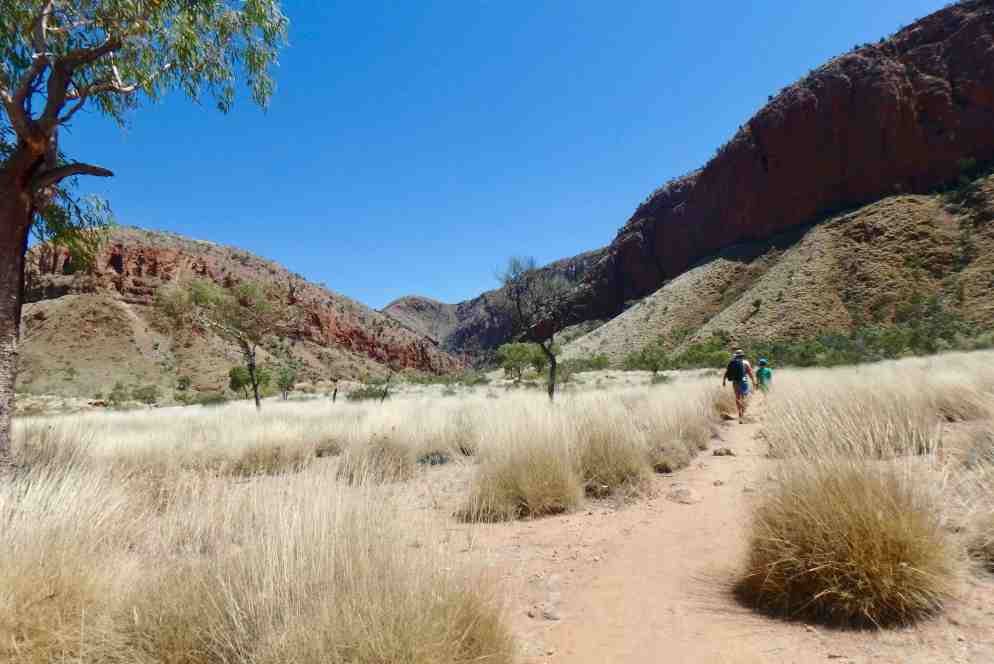
After getting a couple liters of water, we headed to Ormiston Gorge and opted to take “The Pound” hike. I was curious as to why this trail was named “The Pound” and discovered “the pound” refers to the basin formed by the ring of mountains which book-end the MacDonnell range with Mt. Giles on the east and Ormiston Gorge on the west. The seven kilometer Ormiston Gorge Pound walk is a loop hike of the pound and gorge. It initially, gently climbs the lower hills, moves to a definitive pass from which the views are stunning of the pound. It descends onto the flat floor of the pound, and returns up the dry riverbed to the main waterhole.The rugged gorge walls of red, sunburnt orange and deep purples and the Ghost Gums growing up along the ridges and walls of quartzite and the layered rock formation along the river bed were quite beautiful.

In the early section of the hike the trail was flat, meandered along the road and a dry river bed with spare vegetation. I was beginning to think this hike would pale in comparison to the last ones we had done in Uluru and Kings Canyon. But it slowly began to climb hills, with several switchbacks and the tan sands giving way to red rock and ridges, until we were heading towards a saddle.

It was quite a scene to reach the saddle and see the expansive pound fanning out below. It clearly was a panoramic view of a basin surrounded by ridges and hills.

The trail led down into the pound and at that point we encountered sandy beaches of mostly dry riverbeds, though there was one small water hole. It was a good stopping point for lunch which was accompanied by an annoying chorus of buzzing flies. I donned my net and found a way to sneak food into my mouth without letting flies in. Thankfully, when on the move the flies were tolerable and a very minimal nuisance.


This well defined trail crossed the pound and was a combination of soft and harder packed sand, tussock grasses and other desert shrubs, interspersed with a variety of rocks. I was fearful that it would be a heavy slog through soft sand in the early afternoon sun. We crossed the dry sandy rocky Ormiston Creek bed at least 3 times due to it’s looping course.and at the third crossing it seemed like the rocks were increasing and multiplying exponentially. In retrospect I found the sand easier walking than the rocks that loomed in front of me.
OLYMPUS DIGITAL CAMERA

The trail gets harder as you get closer to the Gorge. Soon we were scrambling, trudging, rock hopping, even stumbling further up the riverbed into the gorge from the pound. Sandy stretches, gave way to massive cubist like rock formations interspersed with enough moderate sized rocks to for us to engage in some “creative dance” to keep moving ahead. At points the trail was all boulders and rocks. River rocks coupled with the rust red walls, greenery and the layered formation of the gorges made for a spectacular scenery and I marveled at the array of colors of the rocks and boulders which spanned from the red and orange palette of colors and moved into many shades of mauve, purple and blue.

Sand clinging to the bottom of my hiking boots and loose sand on the surfaces of the rocks made a potentially hazardous combination and I caught myself slipping and falling on three occasions. Negotiating the rocks with beautiful scenery continuing to unfold the higher we climbed into the gorge was challenging but quite the feeling of accomplishment. Eventually we came upon a lovely oasis – a water holes in which a few young men were swimming. Since there was quite a sheet of brilliant green algae on portions of the surface of the water, I could not imagine diving in.

But after crossing to the left side of the water hole and rounding another bend not too much further up, we cam upon a much larger permanent water hole which was exceptionally inviting and was hosting several swimmers. It was just too much for us to be viewing a beautiful water hole with a magnificent backdrop and not immerse ourselves – so we doffed our shoes and jumped in in our clothes with a definite very loud yelp, proclaiming the water to be extremely chilly. But a chill after hot was a great feeling and a very refreshing finale for moderately difficult hike. And, off course the reward of cokes and/or ice-cream from the small concession at the end was definitely a plus.

It was time to get on the road, back to Alice Springs but first a stop at the ochre pits. They consisted of delicate colorful cliffs made up of layers of mudstone and silica in West McDonnell NP. The shades of the ochre range from crimson to yellow. The different colored layers are caused by the presence of iron oxide in varying amounts. The more iron oxide present, the darker and redder the color. These cliffs were a beautiful “canvas” of colorful curves and swirls. It was especially interesting to see knowing how the ochres play an important role in aboriginal ceremony. Though not a seemingly very popular stop I am glad we took the time  to see the ochre pits.

The next stop was our hotel, the Doubletree, and a needed re-grouping for our morning flight back to Brisbane. After many camp meals, we also opted to dine out and I suggest the Red Ochre Grill as it was one of the very few places that advertised serving bush tucker. Bush tucker, also called bush food, is any food native to Australia and used as sustenance by the original inhabitants, Kangaroo is bush food. Since up to this point I had not seen one kangaroo in the wild, I decided I would order one up on a plate in the restaurant. I ordered a kangaroo fillet chargrilled, with a shiraz glaze, served medium rare, on a roasted mushroom tartlet with a salad of maple bacon and apple. It was served beautifully and absolutely delicious and quite a welcome change from canned refried beans slithered onto a burrito, though with the gourmet touch of a slice of cheese in it. The others were not quite so adventurous with their food.  The following morning we were on a plane first to Adelaide and then on to Brisbane. Luke is very very interested in anything related to airplanes so he was in his glory filming the takeoffs and landings of a couple our flight.


Watarrka National Park (Kings Canyon) Northern Territory, Australia

We left camp at 7:45 for Kings Canyon in Watarrka National Park. It is often referred to as Australia’s Grand Canyon and is known for it’s soaring red sandstone walls and is part of the George Gill Range. The walls of Kings Canyon are over 100 meters high, with Kings Creek at the bottom. We intended to hike the King’s Canyon Rim Walk, a 6K (3.7 miles) with sweeping views of the gorge and surrounding landscape. The day was mild enough (it is closed if projected temperatures are 36 degrees) so we headed out on the walk around 8:30am.

There is a steep climb up at the beginning of the walk (the locals call it “Heartbreak Hill” or “Heart Attack Hill” due to its steepness) ascends to the top) treats one to spectacular views of the vivid orange-brown gorge below and of the surrounding landscape. We anticipated a 3-4 hour adventure. I was feeling quite challenged and felt winded about a third of the way up this first rock “staircase”. I realized I was trying to keep the brisk pace set by Nick and Luke – many years younger than this older adult. Settling into my own pace, I marveled at this impressive eye candy landscape. I keep thinking of how my definition of “eye candy” has evolved over time. At one point in life it was definitely handsome men but now it is breathtaking landscapes!

We opted for a 600 meter side trek to the Cotterills Lookout and it was well worth the challenge of negotiating the multilayered sandstone domes to get to the vantage point. I love the challenge of finding solid footing for my “safe” path up these adrenalin injecting rock outcrops! At times it was a bit frightful given the brisk wind and the crevices between the tiered sandstone “hills” thus requiring a bit of rock hopping. From this vantage point the cliff edges are spectacular.


About half way through the walk we descended down into the canyon via a staircase to a bridge across the canyon bottom. A permanent waterhole was visible but due to the arid conditions and lack of rainfall the amount of water was scant. Vegetation in the creek bottom is abundant and ancient ferns abound which are estimated to be over 400 years old.


We ascended up the staircase to the other side of the canyon. The last half of the walk passed through a large maze of weathered sandstone domes resemble ”beehives.” and often identified as the “Lost City.


The primary rock of Kings Canyon is formed of Mereenie Sandstone, a clean white sandstone. I was quite surprised to see broken sandstone almost white inside. The red exterior color is thought to be due to iron-rich dust blown onto the rock surface. It becomes chemically fixed to the sand grains by a form of fungi which thrive on iron, silica and rainwater.


After a brief rest we opted to take the two km out and back King Creeks walk tracing the bottom of the gorge. The entire creek bed up to the turn around point was a a completely dry bed with no waterholes. It was lined with tall trees and mostly shaded. Due to a rockfall the viewing platform was closed but having been able to hike the rim loop we were not too disappointed. Up until this hike I never felt through our travels that the flies were bad enough to warrant the fly net.  However I decided to get out the fly net as there was a very pesky constant annoyance. As on most of the hikes, since so much hiking earlier in the summer in Colorado with Tasia and Amara, one fun way to stay engaged in the surroundings is to find faces (and animals) in the rock formations, trees trunks and deadwood. I was psyched spotting a “skull” and “worm larva.”


Kata Tjuta National Park, Northern Territory

Our journey through the Red Center Way continued post-sunrise at Uluru with the drive to Kata Tjuta National Park, 50 km north west of Uluru. It is listed as a UNESCO World Heritage site so we anticipated another amazing experience. Our plan was to explore Kata Tjuta via the full circuit of the 7.4km Valley of the Winds walk. I anticipated a walk that would engulf me in another stunning patch of the Australian Desert. It had been suggested that the Valley of the Winds walk was an alternative to climbing Uluru and offered awesome views of the landscape from two lookout points along the circuit. The walk was sometimes steep, rocky and difficult and had been rated a rugged class 4 hike (high level of difficulty) but overall was I was able to negotiate it with reasonable caution on the steepest rockiest sections. The temperatures were warm but not near the point where they close the walk due to danger of heat and dehydration. Kata Tjuta is 36 red rock domes that make up “The Olgas.” Kata Tjuta is a aboriginal Pitjantjatjara word meaning ‘many heads’. The Olgas has historical significance and offers amazing hiking. The views awere breathtaking and were worth the effort of driving over and taking the walk.Another great benefit was it was much less crowded than Uluru.

Reaching the peak of the valley was the most challenging part for me. We again followed our “sandwich formation” with Nick and Luke the top crust, myself the filling, and Miriam the crust at the bottom. The first section was a gradual 2K cobbled, mildly rocky and graveled moderately difficult walkway to the Karu Lookout.

At that point the track split and we headed counter-clockwise to the Karangana Lookout. We were headed for a space between the domes at which point we could see below to the Valley of the Winds. During this climb to the lookout we were surrounded on all sides by steep rock faces. There were many steps, some steep rock domes to climb, challenging decent (I find that descending is much more treacherous the climbing and ll my falls and skids are on loose gravel and stones on rock steps and paths. I walking between sheer walls, up steep “staircases” and felt exhilarated by the challenge.


Leaving the lookout we had to negotiated some steep rocky terrain to enter the Valley of the Winds.The valley crossed the plain below through the dry grass, dry creek beds, spinifax, and desert flora and fauna and it becomes a true experience of the Australian outback. I had that feeling of being in the middle of no where. I could see towering rusty red domes, wildflowers, a clear blue sky, gentle winds and a variety of outback vegetation. This desert atmosphere is dry, very dry and though the sun was not yet of the scorching as one might experience in the summer months I felt a real need to consume minimally a liter + of water to keep hydrated. The dry air evaporates the moisture around me and even with the water I managed to get dehydrated. The one advantage of this, though I don’t recommend it as a technique, is not having to duck into the sparse bushes to eliminate the excess water!!! I wonder how all of the plants can survive I wonder how all the plants survive in this arid rocky area?

We all agreed at the end of the walk that it was exciting, challenging and much preferred as a hike to the flat terrain of the circumvention of Uluru. We still had to break camp and wanted to be on our way to Watarrka (Kings Canyon) and had a 350 km yet. So we managed to be out and the road by one o’clock, backtracking first the 50k to Ayers Rock campground and then on to the Lurijata Road to the Kings Canyon Resort. When I hear the word “resort” I mostly think of an moderately upscale hotel/motel with many amenities. The outback resorts are much more rustic in my opinion. We checked in and headed to the communal camping “lawns.” We had several areas to choose from. One was near a noisy gas station and bar, another right by the pool and the camping area for the busloads of high schoolers, and the third was a large empty red dirt lot, spare of trees. There was little vegetation (nothing resembling what I think of as a lawn) on it and the dirt was so fine I kept thinking of chili powder or paprika. We opted for the far end of the red dirt lot which had a spindly tree for shade and we hoped protected from the worst of the noise. We finally found the communal stoves for cooking in between a dreary looking bank of mortal room. The car hood was our table and we found ways to not have to sit in the chili powder. Here we needed to make sure all food was secured in the car due to the dingos roaming the area As it was getting dark we realized the “loud couple” and there loud friends were setting up camp right next us in the middle of this dirt field. We were a bit dismayed at the inconsiderateness of there rather noisy conversations and robust laughs that went on pat our bedtimes. Fortunately we all were tired enough to eventually fall asleep.


Uluru National Park, Northern Territory

Uluru National Park (Ayers Rock)

Whenever I thought of Australia throughout the decades of my life I alway thought of the iconic Ayers Rock, though now more appropriately named Uluru, the aboriginal name. Having made two trips previously to Australia I had yet to date visit this “island mountain” and was eagerly anticipating a holiday there with son Nick, Miriam, and grandson Luke during this visit.

We set off for the airport early on Saturday morning, September16th. After leaving the car at the off-airport car park and negotiating the bus to the terminal with our two large suitcases stuffed with an array of camping equipment and clothing, we breezed tough security, Australian style. Yes, there are scanners and carry on restrictions but it seems so much more sensible to me to not have to bag all your liquids, take off your shoes etc. etc. I certainly did not feel any less safe.

The views from above during our 3 hour Qantas flight to Alice Springs from Brisbane were amazing. The rugged desert and arid bushland with its striation of gray, pink to red, tan to yellow — sports an infinite array of colors in its planes, river beds and parallel sand ridges and dunes. It stretches for thousands of kilometers and appears mostly uninhabited. Another amazing occurrence was we were actually served a hot sandwich on this domestic flight-a lot more hospitable airline than our US domestic lines for sure.


Upon our arrival in Alice Springs, we hurriedly acquired our hire car and sought food and propane for out drive to Uluru which we had anticipated being a 4-5 hour travel through the bushland with relatively few guesthouse and gas stops. The 500 kilometers drive though Australian bushland might be described as flat, featureless, open shrubby country with very few trees, sparse flora and fauna. The largest concern was to get to Ayers Rock campground before dark due to the danger of feral camels and kangaroos roaming the desert and being a potential road hazard after dark. Additionally it is no easy task setting camp in the dark.

It was a long and somewhat tedious drive given the sameness of so much of the bushland but also I found it quite interesting as this is new territory for me and definitely different from the deserts of the southwest US. I kept looking for those camels and kangaroos. There were no remarkable encounters and we saw nary a kangaroo or camel along the way. The brightest spot was a rest stop at the Eridunda Desert Oaks Roadhouse with its pen of emu’s and much needed toilets. The few roadhouses along the way usually have a motel and caravan park but it did not seem very enticing to me to be staying in the hot sunny bushland/desert.

Camping in Australia has been a new experience for me. The only camping around Uluru is Ayers Rock Campground and though there are reservable sites with electric for campers, many tent campers, as we were, opt for a site on one of the designated “lawns.” Being accustomed to more privacy and site boundaries in US parks and National Forest Campsites it seemed a bit odd to be setting up our tents in a large open area – a “lawn” with several other families doing likewise – and often quite close together. They also have communal “barbies” to cook on which have a gas heated 18 “griddle” type surface. We managed to get set up and things squared away by nightfall and were able to cook under a lighted picnic shelter. I definitely like the “barbie” and lighted shelter amenities. As we began to think about settling in to our tents Nick was hollering at us to look up in the sky. A huge streak of orange burning light was streaming across the sky and appeared to be something shattering and burning up. We surmised it to be a meteor but Nick found an article a couple of days later identifying it as space junk and it was most likely the third stage of a Soyuz rocket re-entering the Earth’s atmosphere.These are usually programmed to burn over the oceans and rarely burn up over land. Even knowing that it still was quite special and spectacular to have seen. AND surprisingly our lawn was quite subdued and I slept cozy in the mid-40 degree temperature.

After a round of hot oatmeal and hot coffee for breakfast to quell the chilly temps we were off to Uluru for a day of hiking. Over the last couple of decades the aboriginal origins and culture have been recognized and honored and the Uluru National Park is co-managed by both the indigenous groups and the Australian government though ownership was turned over to the original aboriginal owners in 1985. As a result much of he land has been returned to its historical origins of being sacred and park guest are asked to honor that. Uluru rock is considered one of the sites and though many visitors come her just to climb the rock, tourists are requested not to do so. We did not hesitate to honor that request though I had originally anticipated the climb. This national park is leased to the Australian government for 99 years so the climb remains open. Even with that request about 30% of the visitors still climb it which I find sad. If the percentage of climbers fall to 20% , the climb will be closed, fully honoring the aboriginal wishes.The challenge then became to walk the base of the rock which is a 10K hike, We had taken a guided walk on the Mali trail which was extremely interesting and informative, seeing the cave drawings, water holes and sacred sites, and the separate caves for the men and women being just a few of the micro stories of the indigenous people..


The Mali walk  put us close to noon, the hottest and sunniest part off the day to circumvent this massive monolith. We headed out and the four of us fell into a relatively consistent hiking order with Nick and Luke out ahead. Luke,10 years, is an awesome hiker and has great endurance. I was not to far behind as I love to keep a brisk pace but don’t have the stride length at 5’1” to match Nick’s stride. Miriam was the caboose as she loves to hike at a slower more relaxed pace and tends to spot more of nature than perhaps I do pushing on faster It was a relatively flat, minimally shaded adventure but I did find the traverse a significant way to try and be in touch with the spirit and souls of the aboriginal people who tread this land currently and historically. Up close the rock has many significant features that would not be seen without walking the circumference. It was inspiring to observe the sacred sites of the aboriginal inhabitants and hear the dreaming and historical Dreamtime stories or the ancestors including the origin of Uluru. “Dreaming is a complex network of knowledge, beliefs and practices belonging to their community, to families and to individuals. It is seen as powerful living force that must be maintained and cared for, it is considered their duty to respect and look after the earth and pass these ancient traditions on for all of time.” (www.the recenter.com.au)


One of the suggested experience to have at Uluru is to observe the Rock at sunset and sunrise to see the effect of the sky, clouds, and shadows on the appearance of Uluru. So after our hike of three hours and 50 minutes, we headed back to camp for a cool down swim in the Ayers Rock Resort very cold swimming pool. As it is a holiday for schools here in Australia, we encountered numerous groups of high schoolers on organized camping and sight-seeing trips. in the various parks we visited. It seemed like at least a couple busloads of young people all decided to descend on the pool at the same time. Needless to say, a quick cool off and then back to the campsite was the agenda I chose rather than fight for space in the swimming pool. We devoured a quick dinner and headed back to the park for sunset.


It is about a 20K drive from Yulara which is basically Ayers Rock Resort and Campground so we were not of a mindset to drive it too often. The rub was that it was almost impossible to rent a car with more of mileage allotment of 100KM per day and since the estimated round trip driving distance was going to be about 1500km without counting day trips we were somewhat budget conscious at 25 cents per km extra. We had given brief consideration of renting a 4WD vehicle and traveling the Red Center Way but they were very expensive and had similar mileage parameter. However being able to drive the section of the road that is still dirt and requires a 4WD permit cuts a considerable amount off the mileage. But when talking to a couple of individuals who described accidents and totaling a car when the hit a patch of bull dust (It occurs when the driving track becomes wet and after drying breaks into a very fine dust and can flip a vehicle) we saw it differently. A bit of initial lamenting quickly shifted to a confirmation that we had made the right choice given lack of experience in 4WD.

Given this particular day and sunset we were quite underwhelmed by the impact of the setting sun as it was difficult to discern any significant color changes , but nevertheless glad to have come. It was back to camp afterwards and getting organized for an early wake up. We were going to go to Uluru for sunrise with Uluru silhouetted against the pre-dawn sky, dawn and rising sun and then on o Kata Tjuta National Park for another day of hiking in the Red Center.

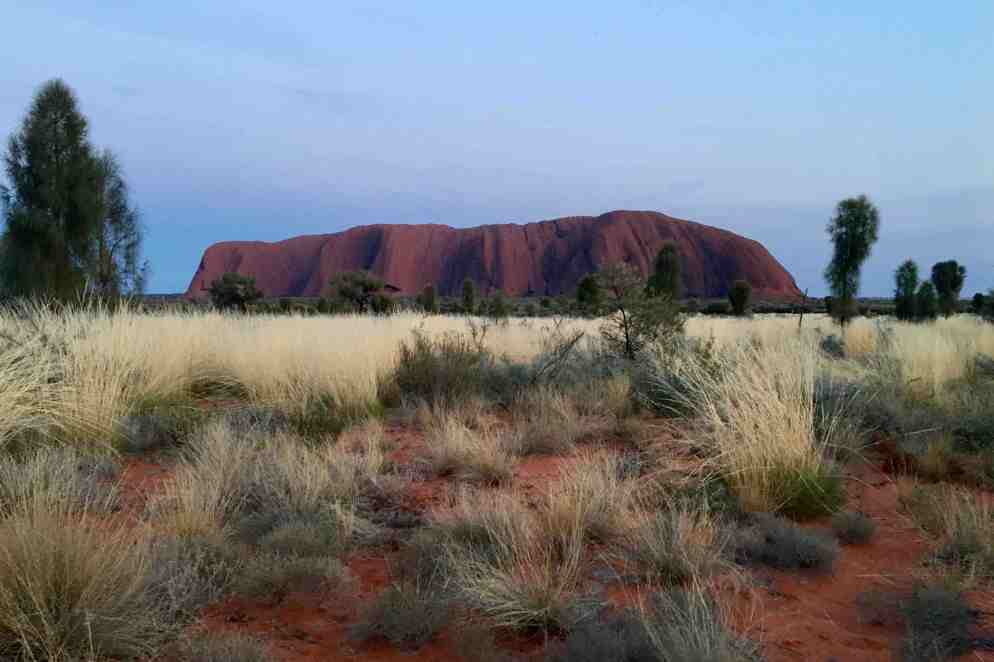
Sunrise was quite awe inspiring we opted to be on the road in the darkness so as to have the full impact of the dawn and the palette of colors before the sun peaks over the horizon. This was a very satisfying and soul nourishing time. I had a deep feeling of tranquility as i watched the transformation of colors in this red center desert with the iconic rock of Uluru as the centerpiece and reflecting on its spiritual significance to the aboriginal peoples inhabiting this area


IMG_2439