A Backcountry Shack, a False Start, and a Roaring Cataract

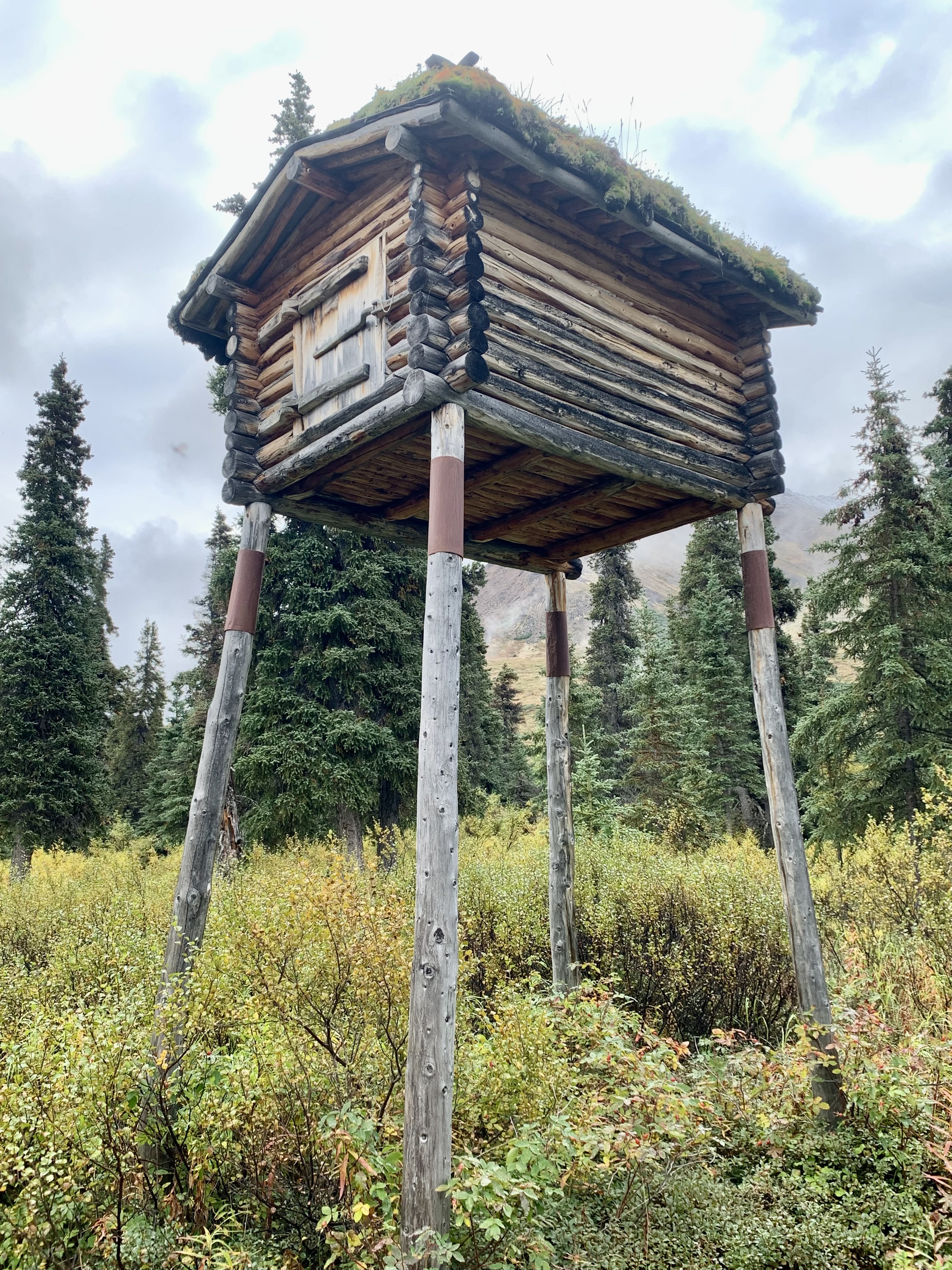
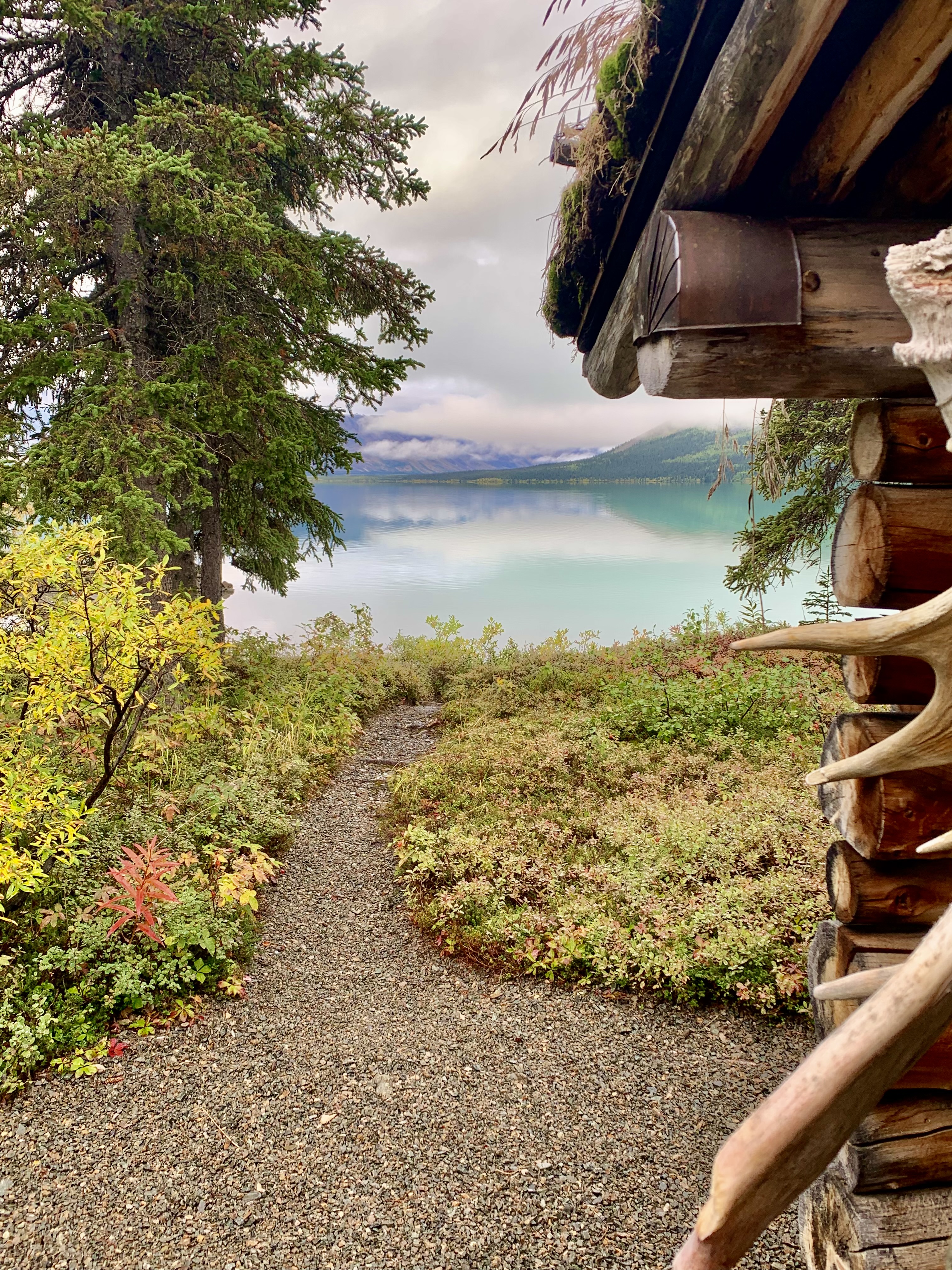
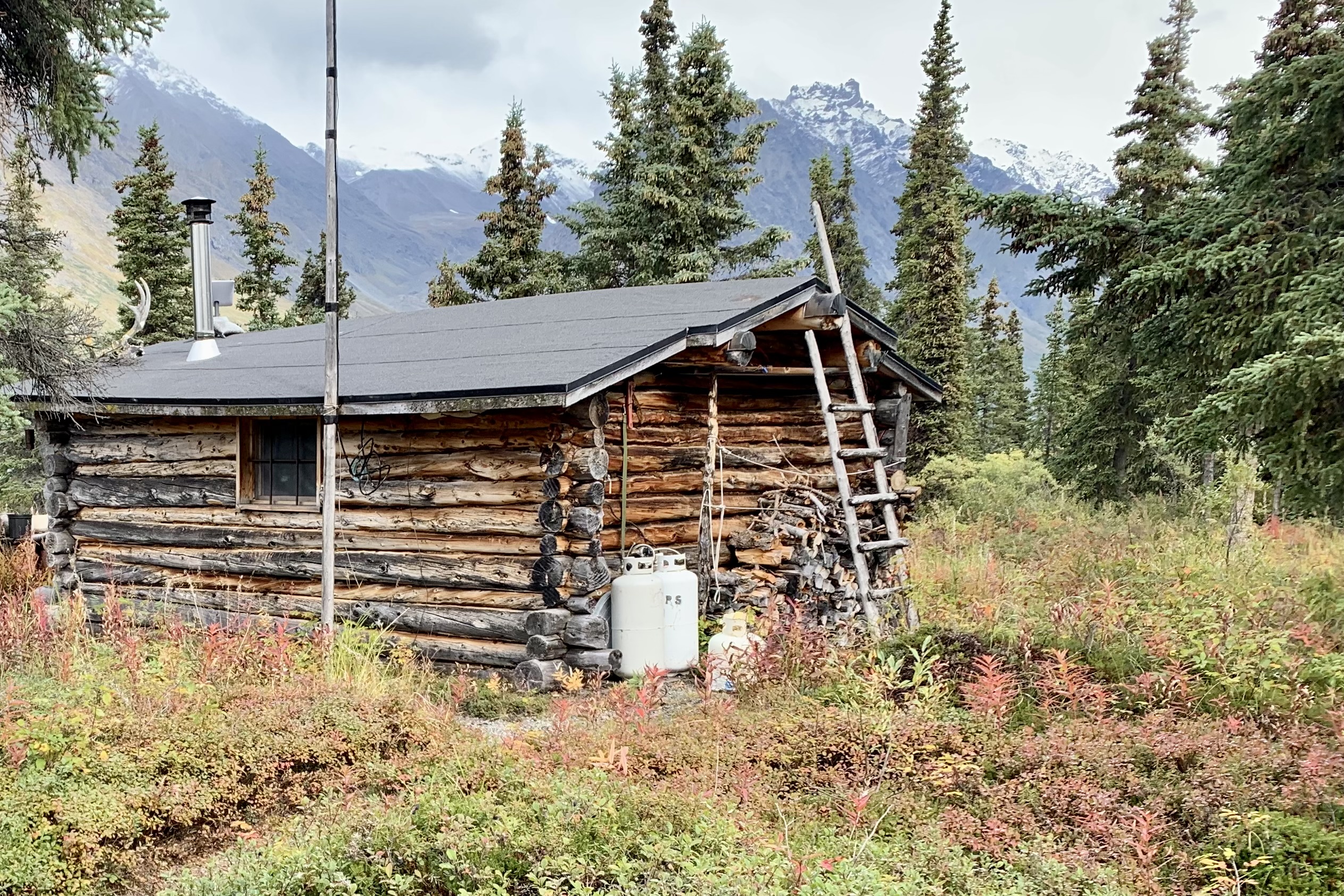
A guided day trip to Twin Lakes was on the schedule for this day. We were advised to be ready for our outing  to Twin Lakes around 10:30 am, somewhat later than our normal 9;00 am plane.  No sleeping in though because breakfast is served at 7:30. The plan was to   drop us with our  guide at Upper Twin Lakes where we would be  exploring the Hope Creek area where Richard Proenneke, aka” Dick”, the embodiment of  wilderness values, self-subsistence, and resourcefulness, lived. From the age of about 51 he lived alone for nearly thirty years (1968–1998) in the mountains of Alaska in a log cabin that he constructed by hand near the shore of Twin Lakes. He definitely is my kind of hero. Dick’s cabin is a National Historic Site and managed by the National Park Service.. We were encouraged to read  a book titled One Man’s Wilderness for some background of the areas, Hope Creek, and Teetering Rock. I had download it the night before and had read about half…at least enough to have a good idea of the challenges he faced in building his home and living off the land.

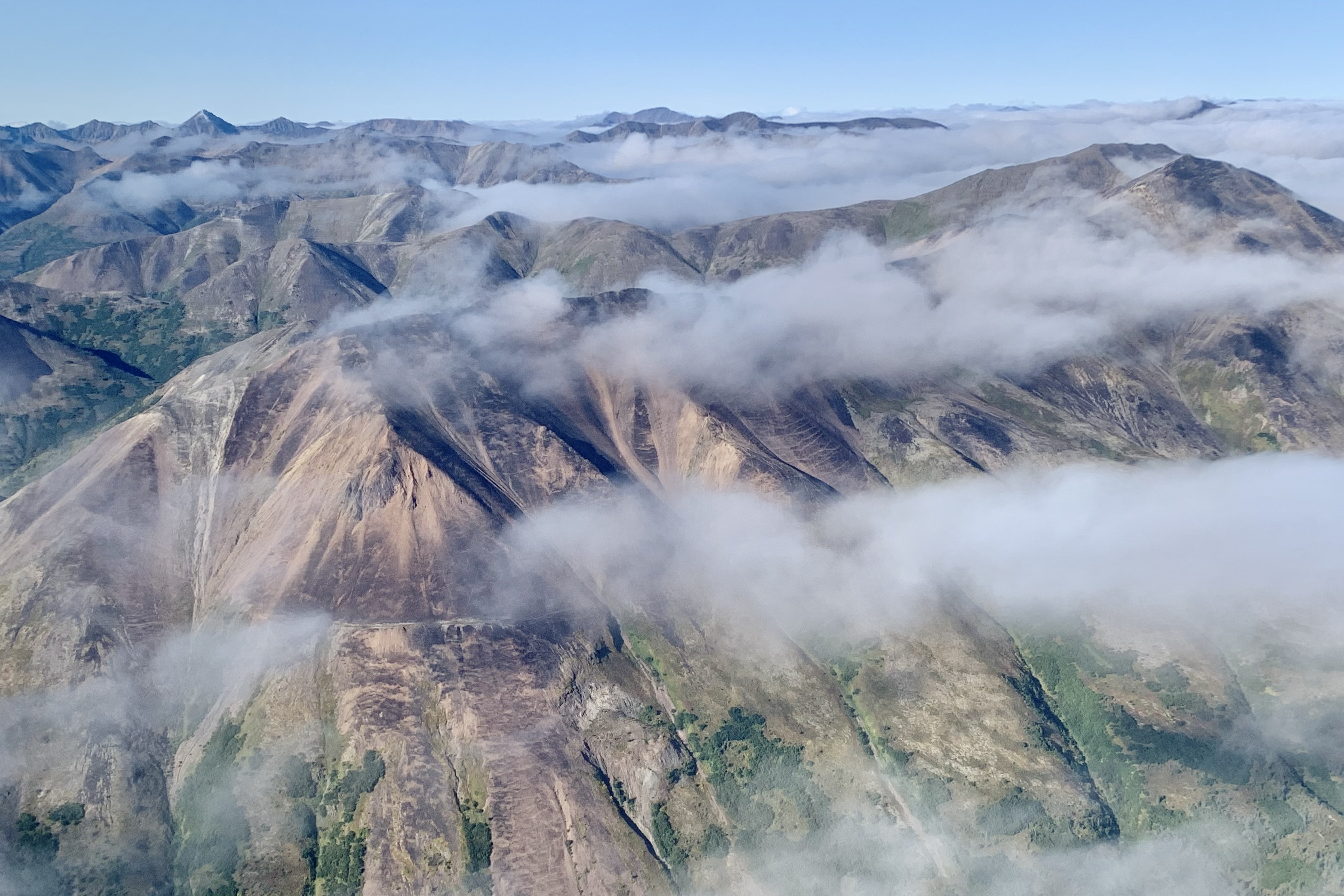
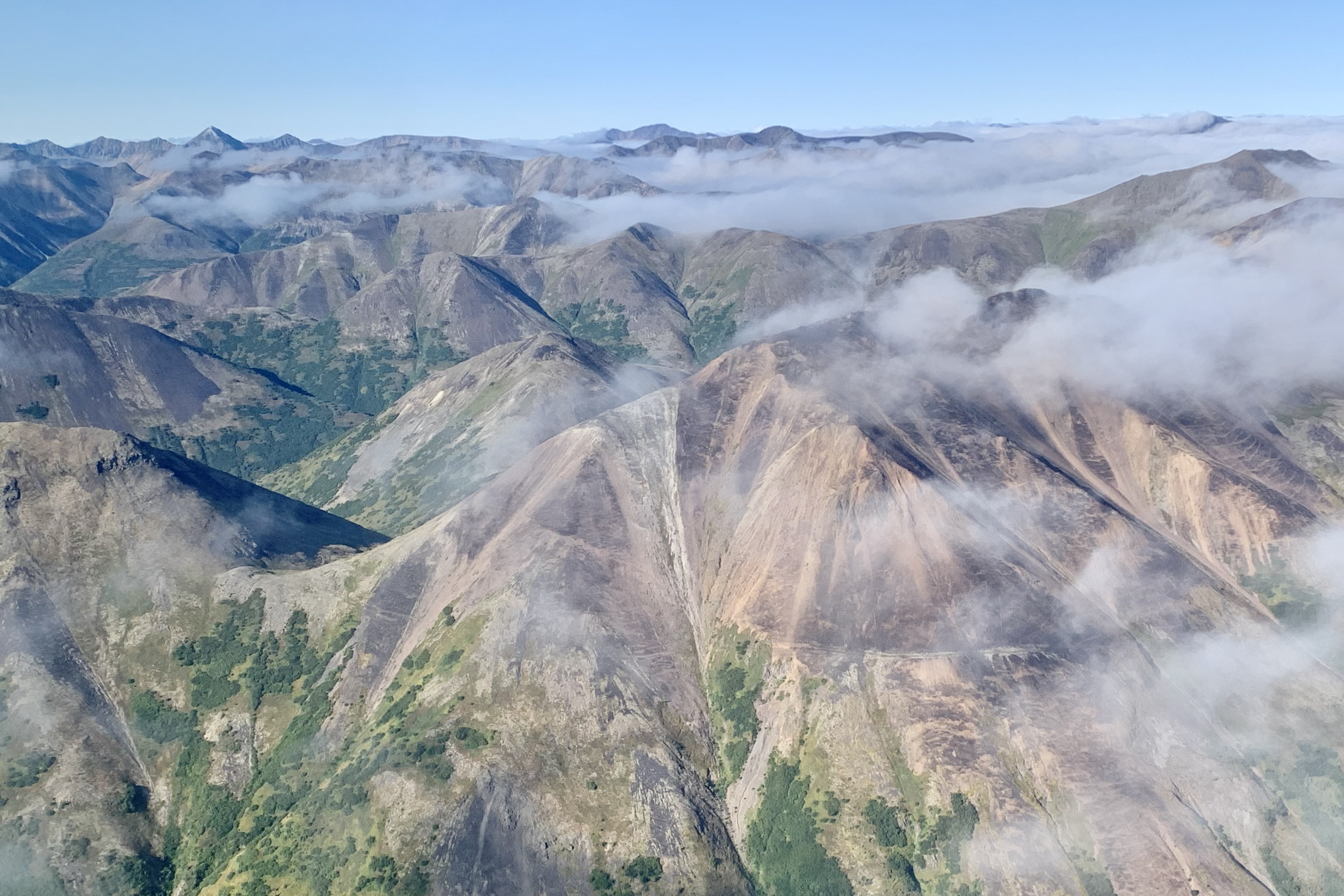
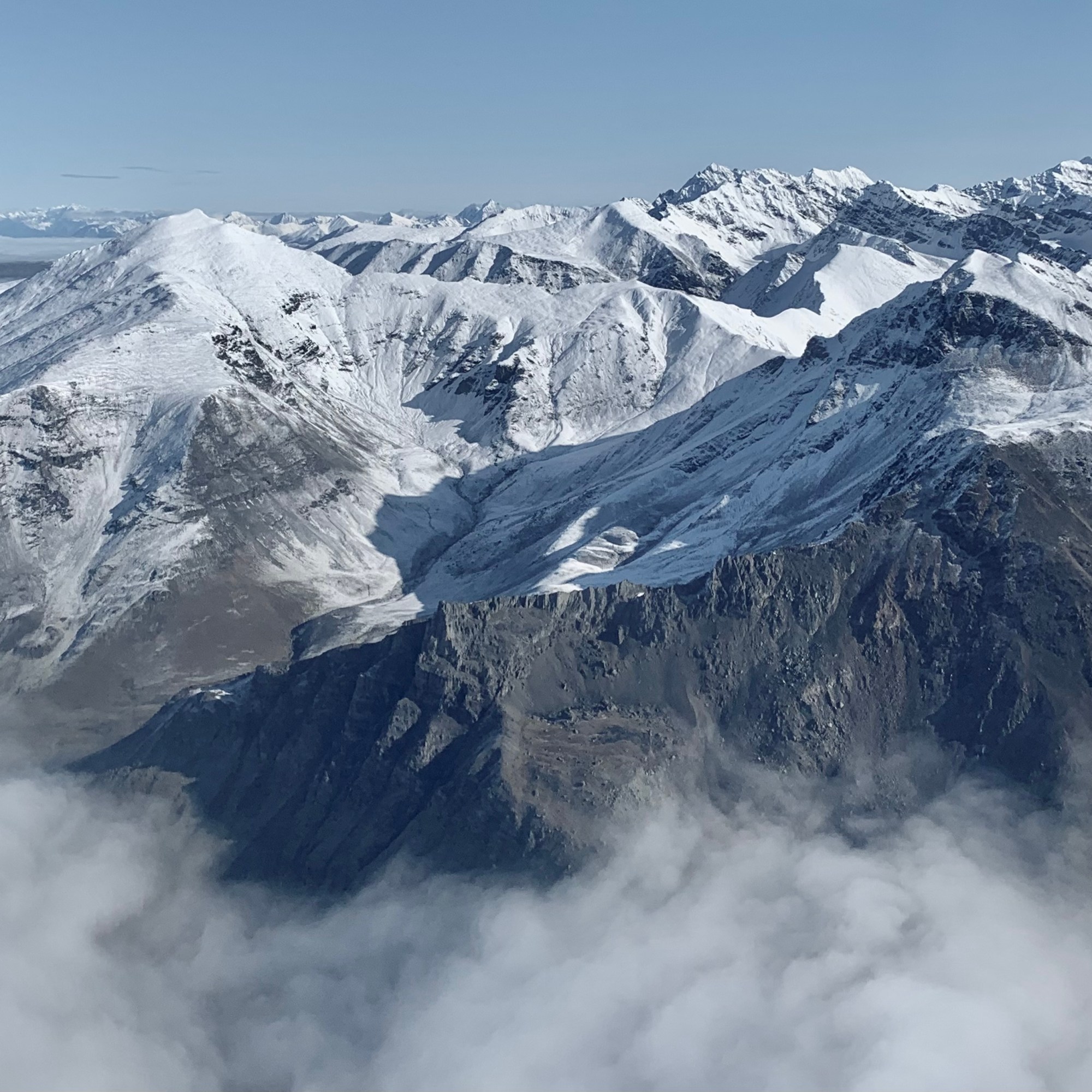
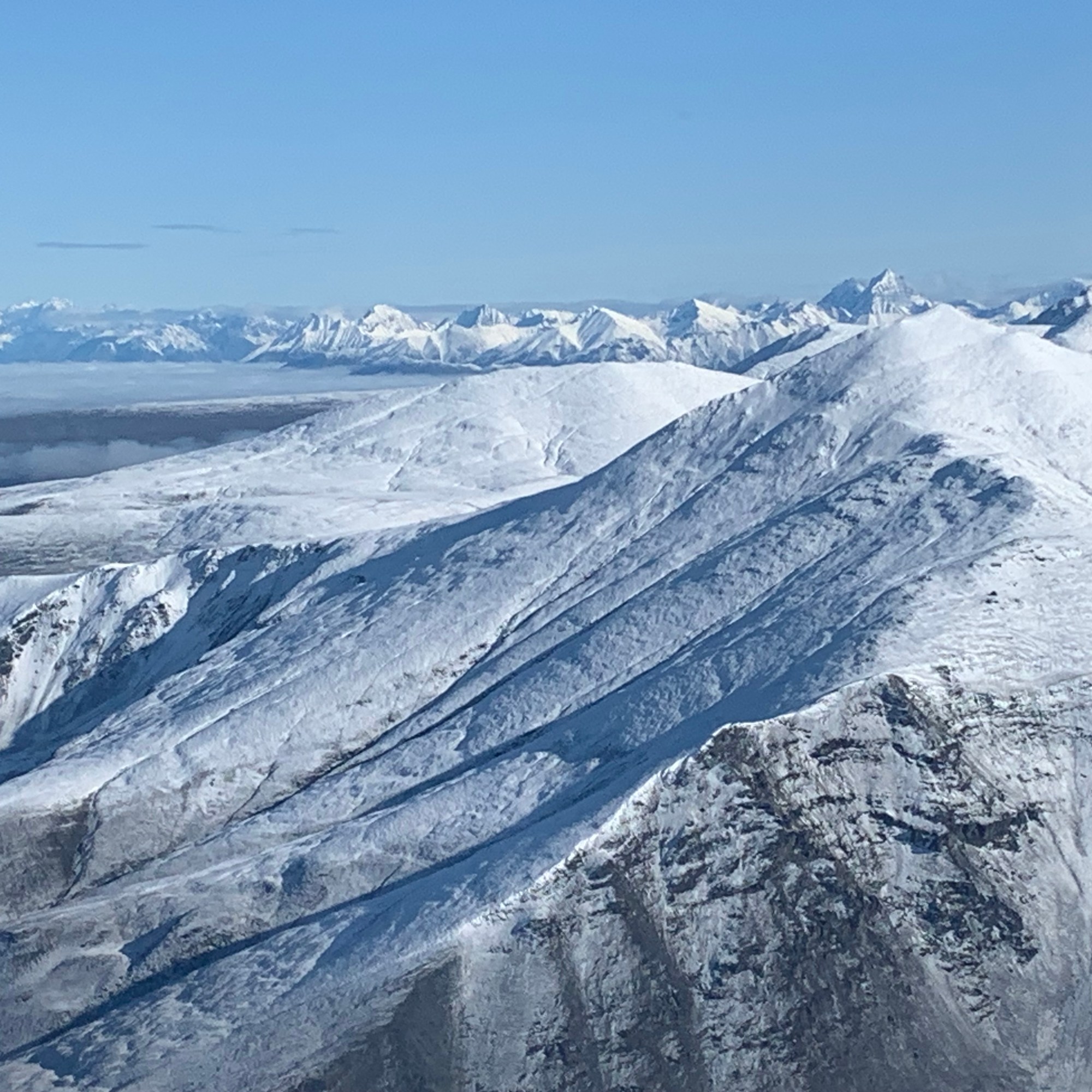
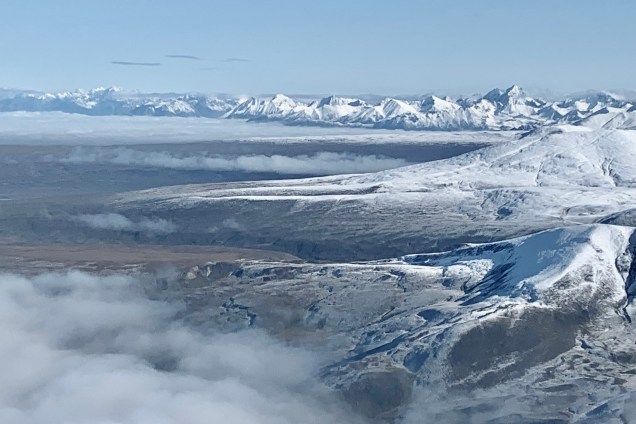
As always, our  float plane adventure took us over other stunning scenery of this vast Alaska Wilderness area. Initially the mountains were of a lower elevation and yet to be dressed out in snow.  The verdant colors never cease to amaze me but before long we were back over the jagged snow covered peaks. 

At times the cloud banks were more like ethereal cloaks and misty veils and other times a sea of  cottony pillows. Sometimes it seemed as if we were floating on thick layers  of the cumulus clouds .  Our pilot charted a course up the western side of Lake Clark over fish Trap Lake and the western area of Twin Lakes. Of course I was wildly taking pictures and I am sure if my camera didn’t date them, at times mark there location, and keep them ordered I might assume they were from a previous jaunt… but it never ceases to inspire awe.

It is always interesting to be privy to the pilot talk between planes as they share the conditions all over the area they are experiencing. It began to sound like our adventure on Twin Lakes was a possible “no go” when listening to the floatplane to floatplane chatter. The micro weather systems in the different valleys can be quite disparate and the gist of it was that Twin Lakes was fogged in and landing there was contraindicated. The pilot also had to take into consideration the forecast for later in the afternoon when we were to be picked up and made the determination to take us back to the Lodge and possibly try again after lunch. Within the hour however we were told we would try again tomorrow. Seems that most of the valleys were in layers of fog and the conditions later in the day would deteriorate further. Guess he didn’t want to drop us and not be able to safely retrieve us especially since there were no public sleeping accommodations at the cabin site. Of course I definitely thought it would be a great adventure roughing it out there like “Hero Dick.”
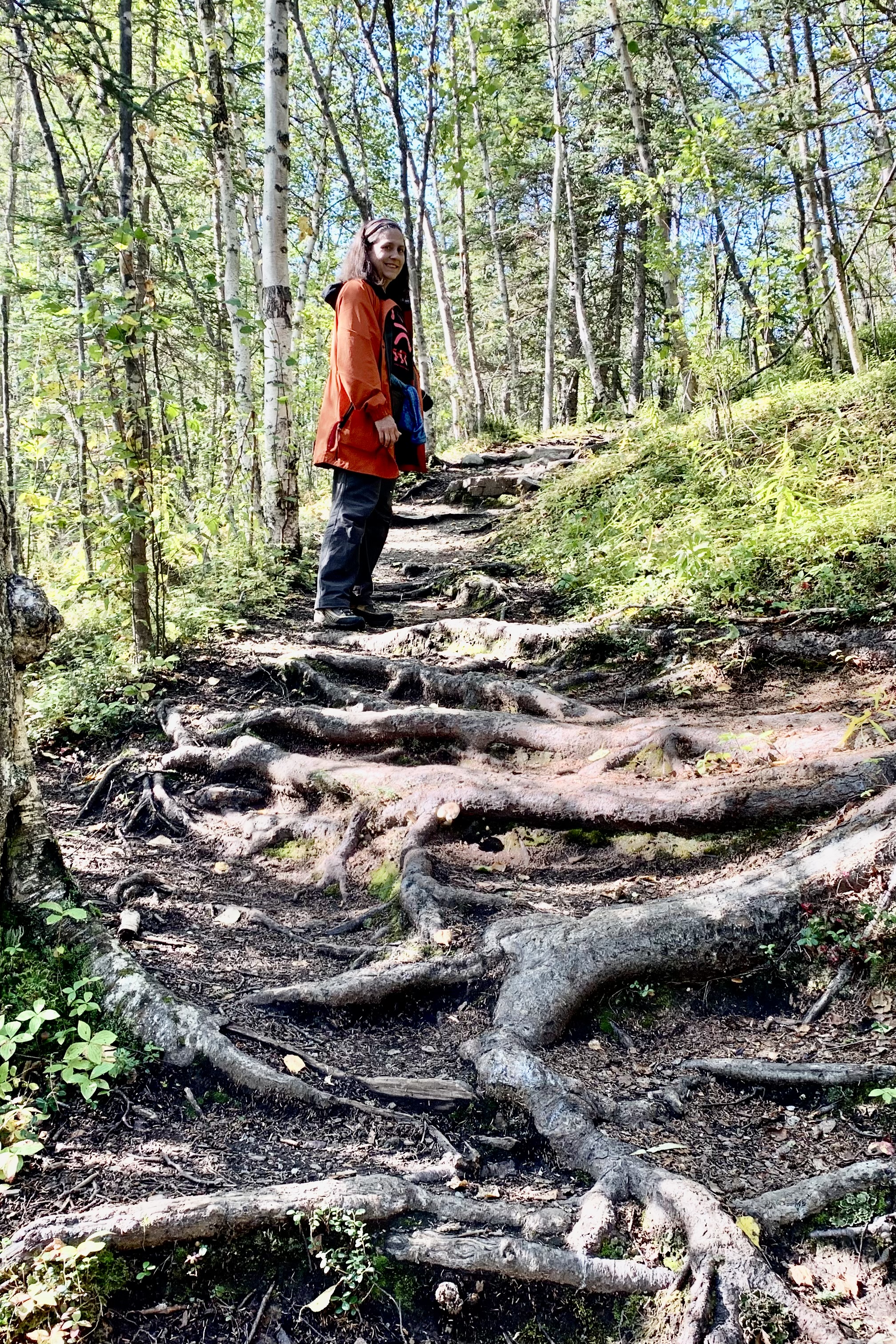
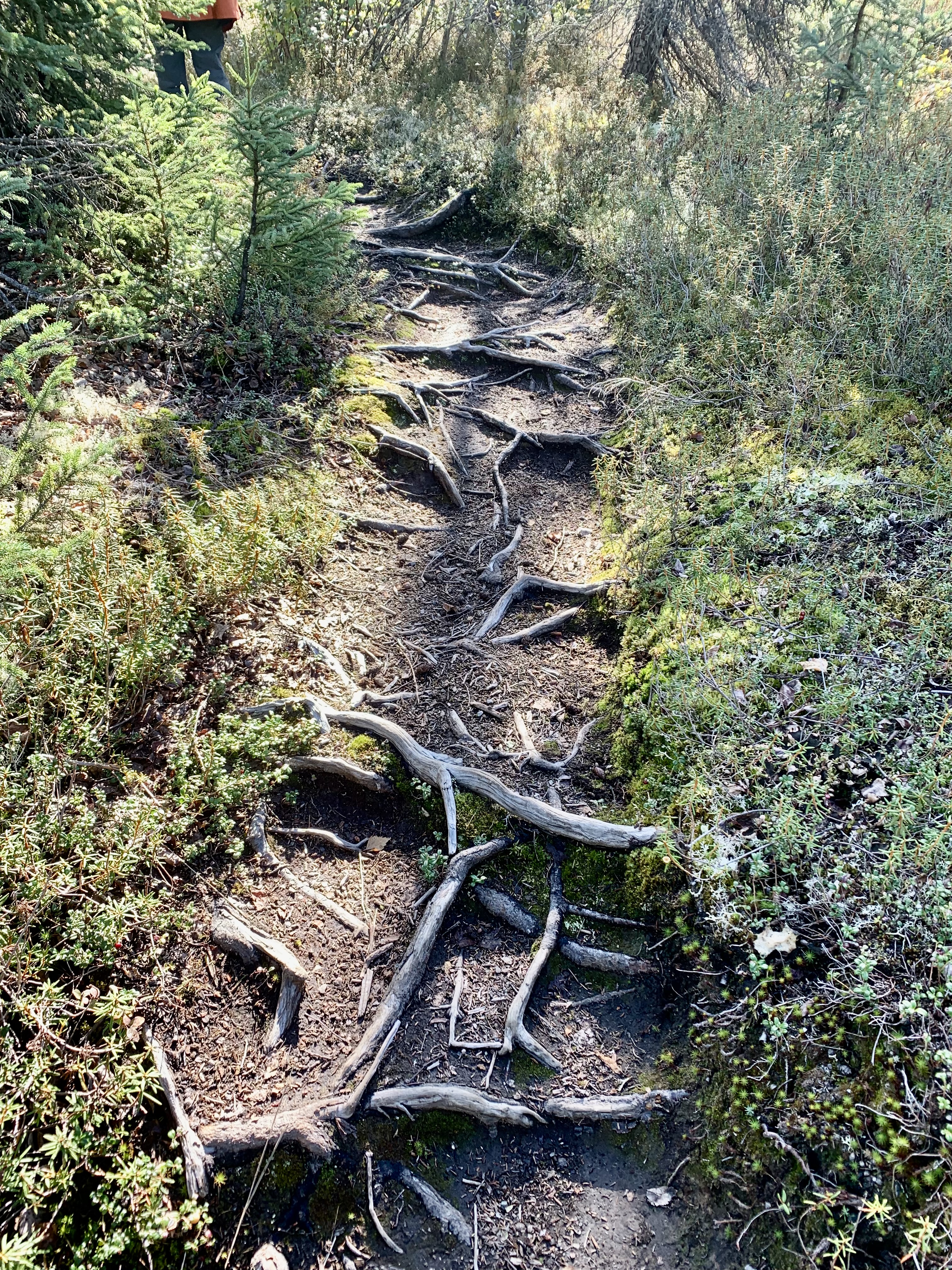
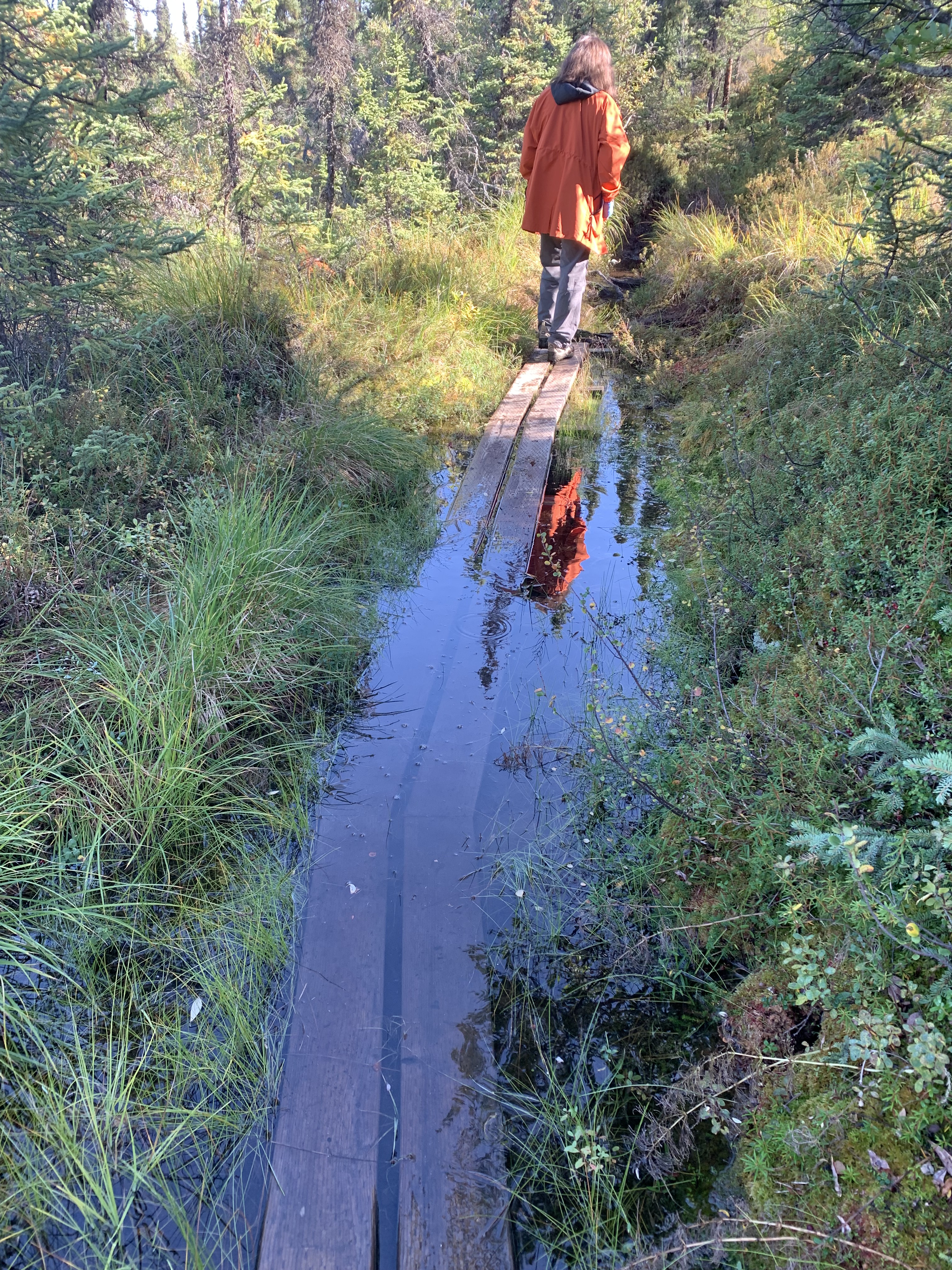
Tasia and I put into action our Plan B which was a visit to the National Park Headquarters and the loop hike to to Tanalian Falls. Naturally though I thought what an adventure it would be to hike the Tanalian Mountain Trail which is described as steep, strenuous and with wonderful views of the area. Fortunately it dawned on me that I have already had many times over the most wonderful views of the area from the floatplane and there was no need to batter my body with a challenging and possibly dangerous hike. So Tasia and I headed out the Beaver Pond Loop Trail on this beautiful sunny afternoon. As I have discovered, most forest trails I have encountered when hiking in Alaska this summer, are staircases of tripping roots, wet muddy bogs, and abounding with a rich variety of flora and fauna, and berries (good grizzly lunchables). It was a delightful to meander upward towards the falls but sadly there were no beaver or beaver dam sightings on this Beaver Loop Trail.
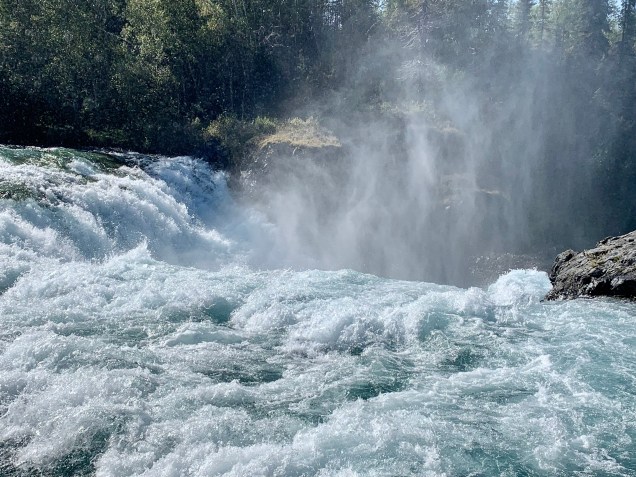
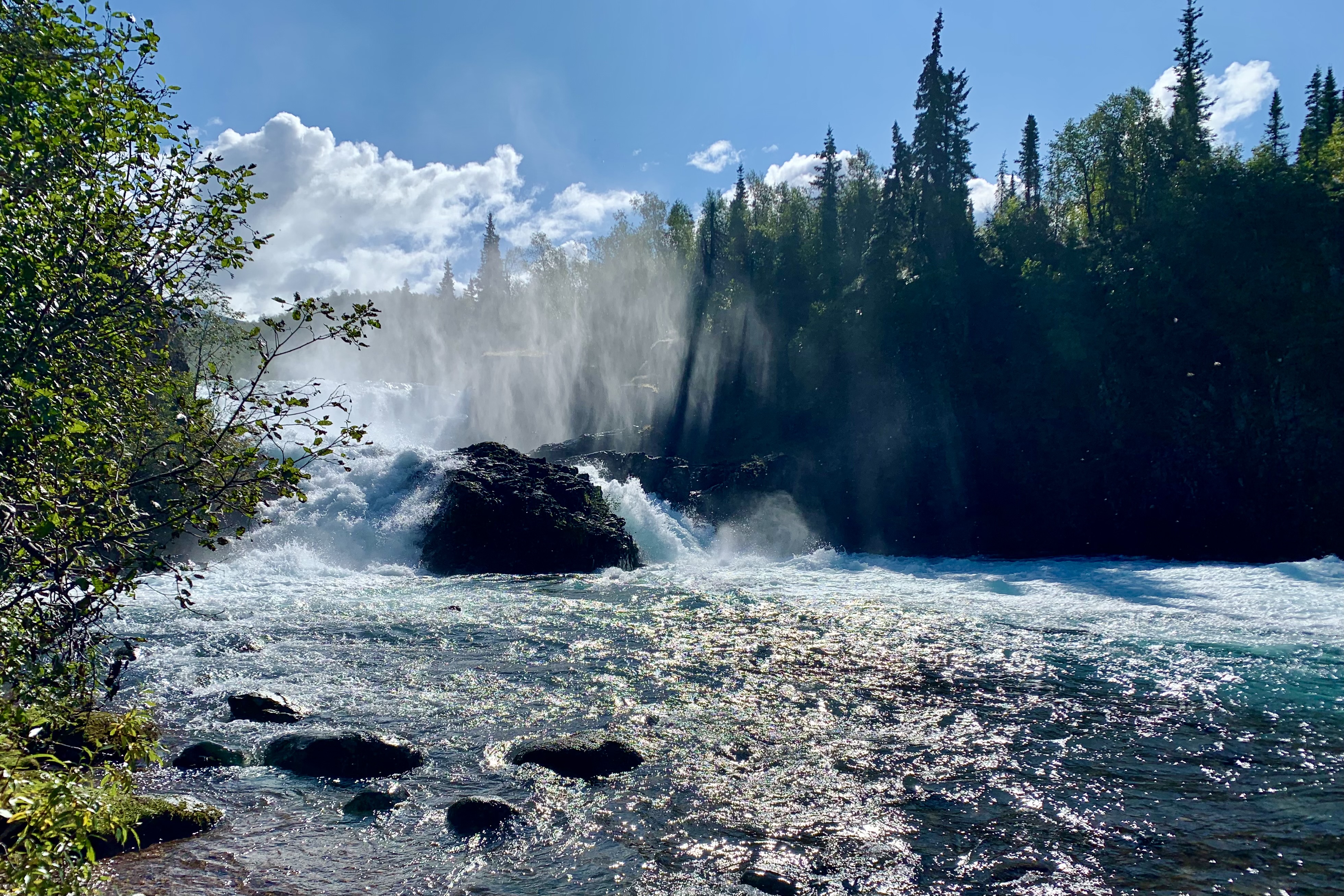
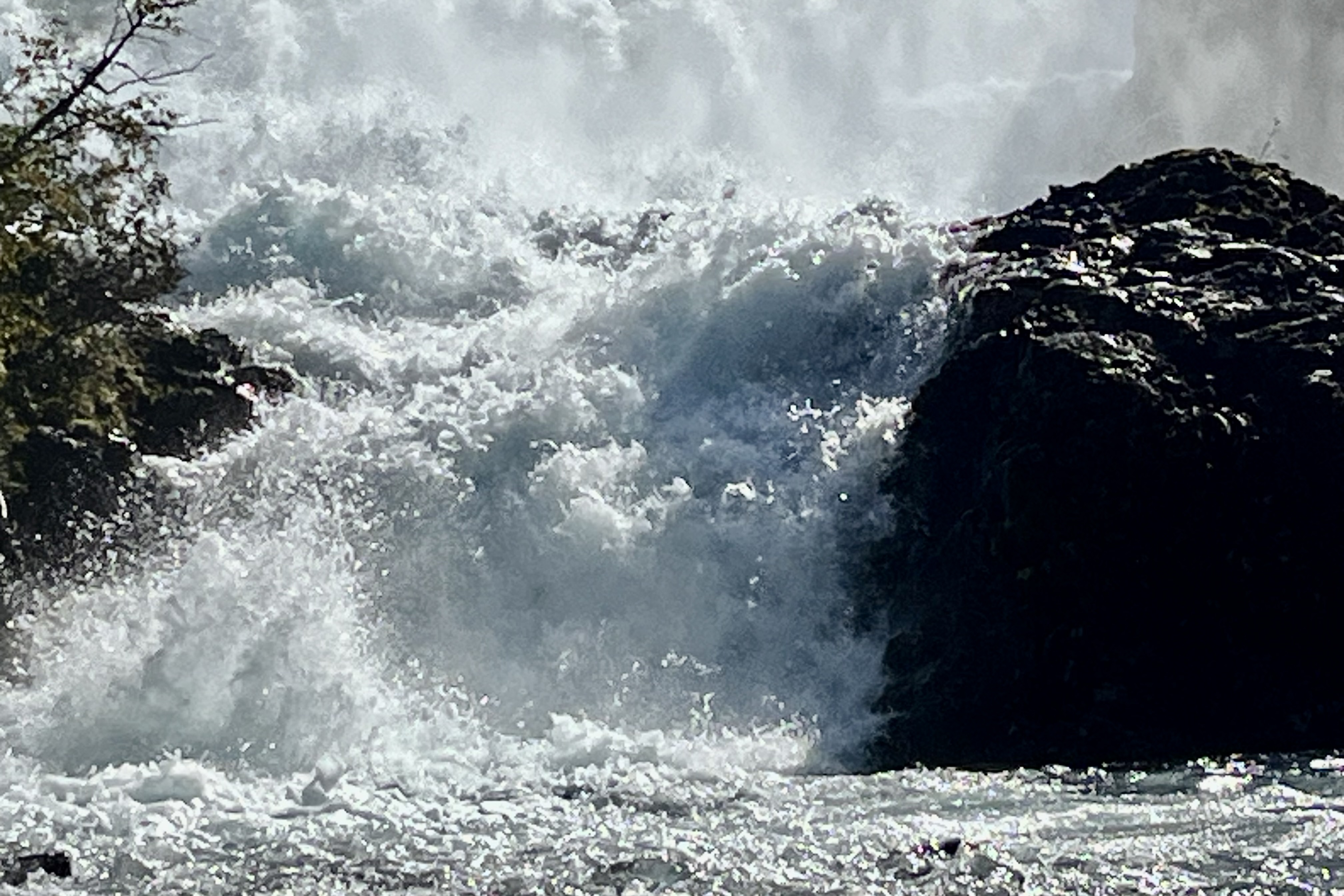
After about two miles of a mostly uphill trek we were finally able to hear the roar of the gushing water and see the mist in the air from the sheer force of the water tumbling down the escarpment. We followed the trail to the top of the falls and it was breathtaking to just stand there and experience the grandeur and power of this cascade of water.
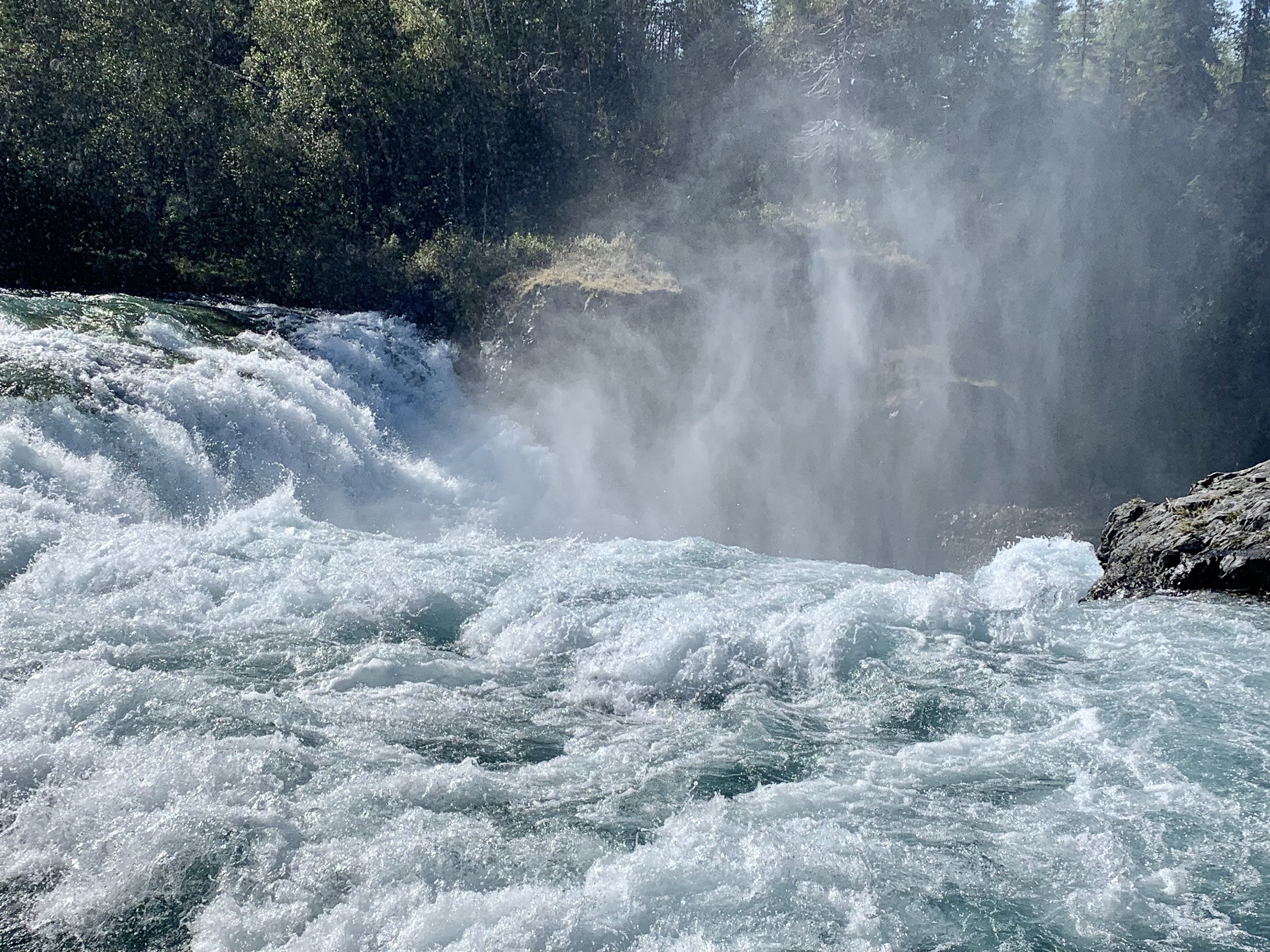
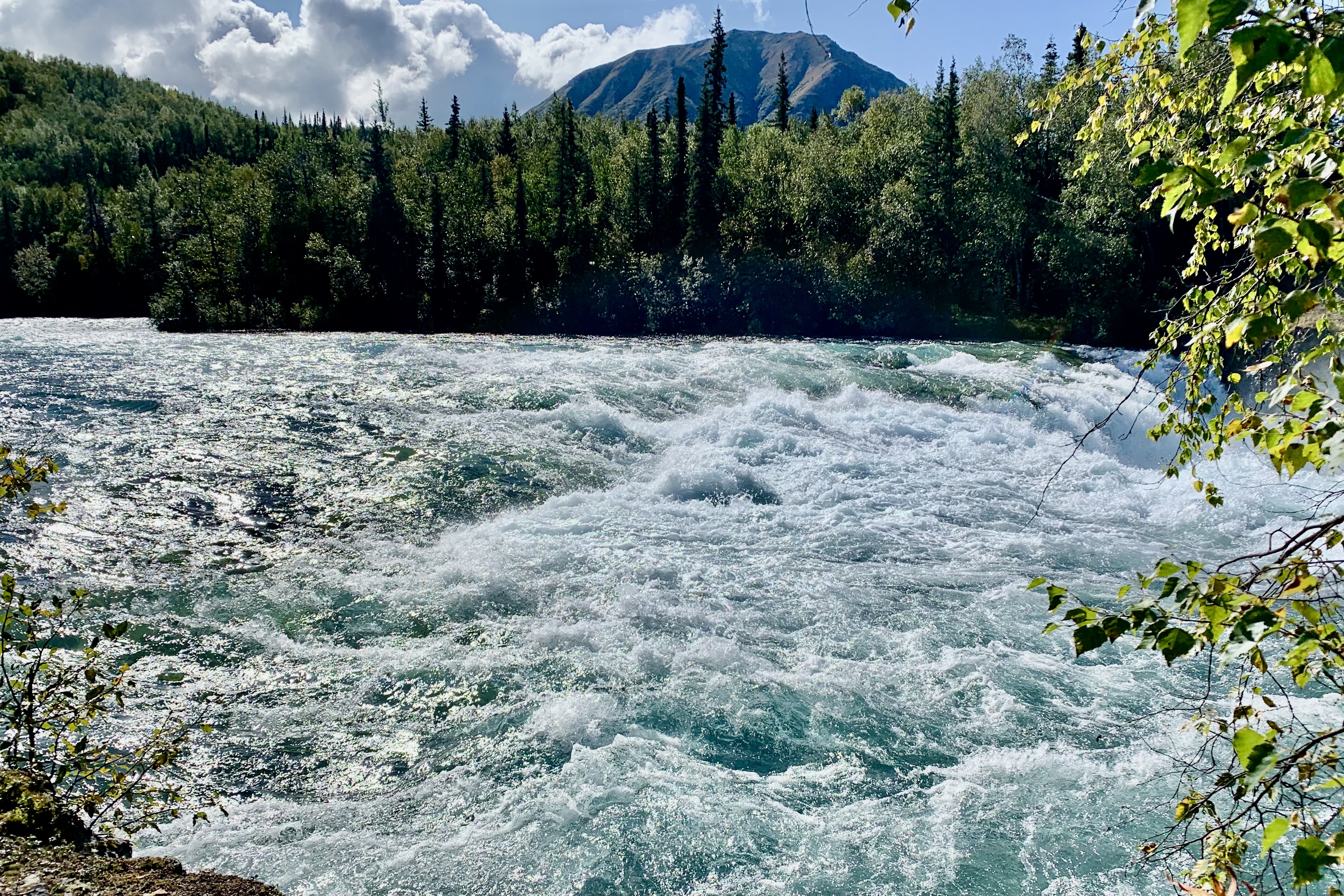
After soaking up the wonderful energy at “top-o-the-falls” we followed the trail back and headed to the bottom of the falls to experience this unbridled power as the water roared into the Tanalian River before we headed back to the forest tail.
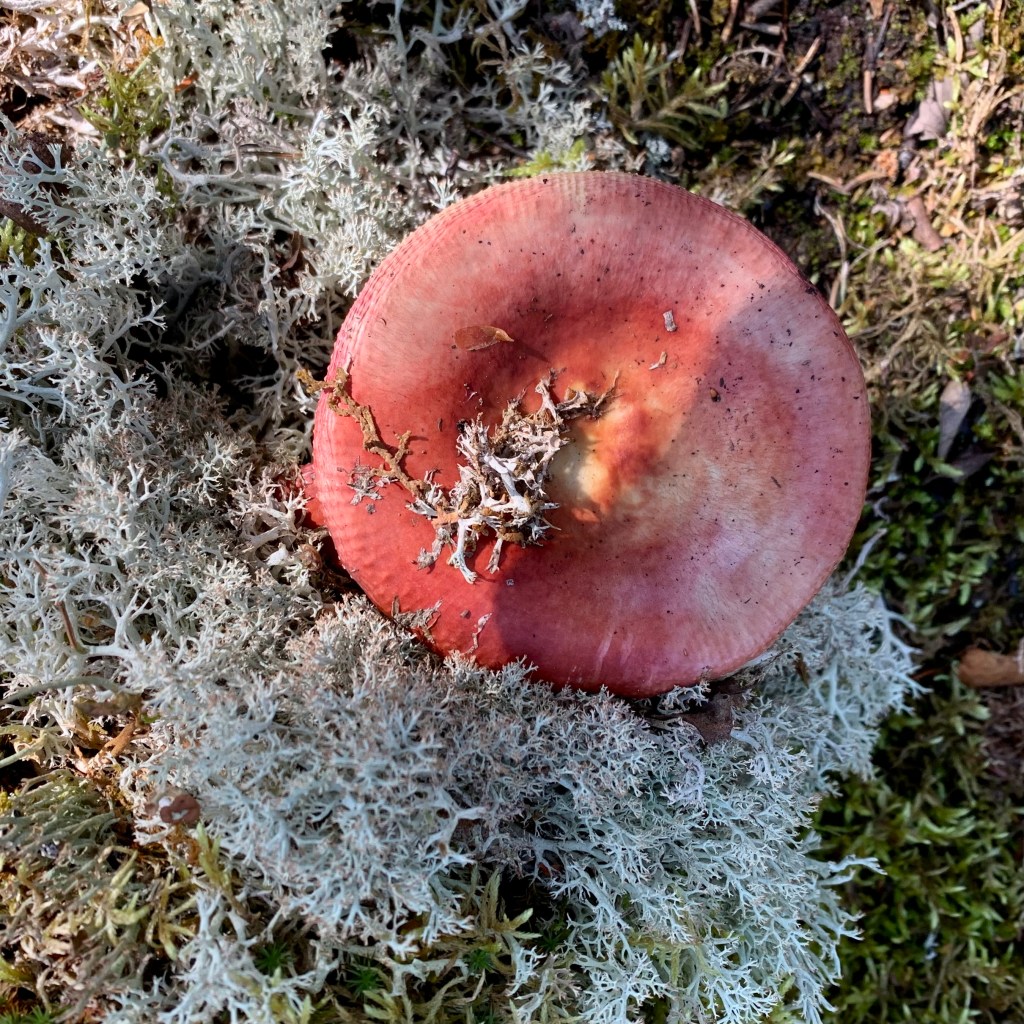
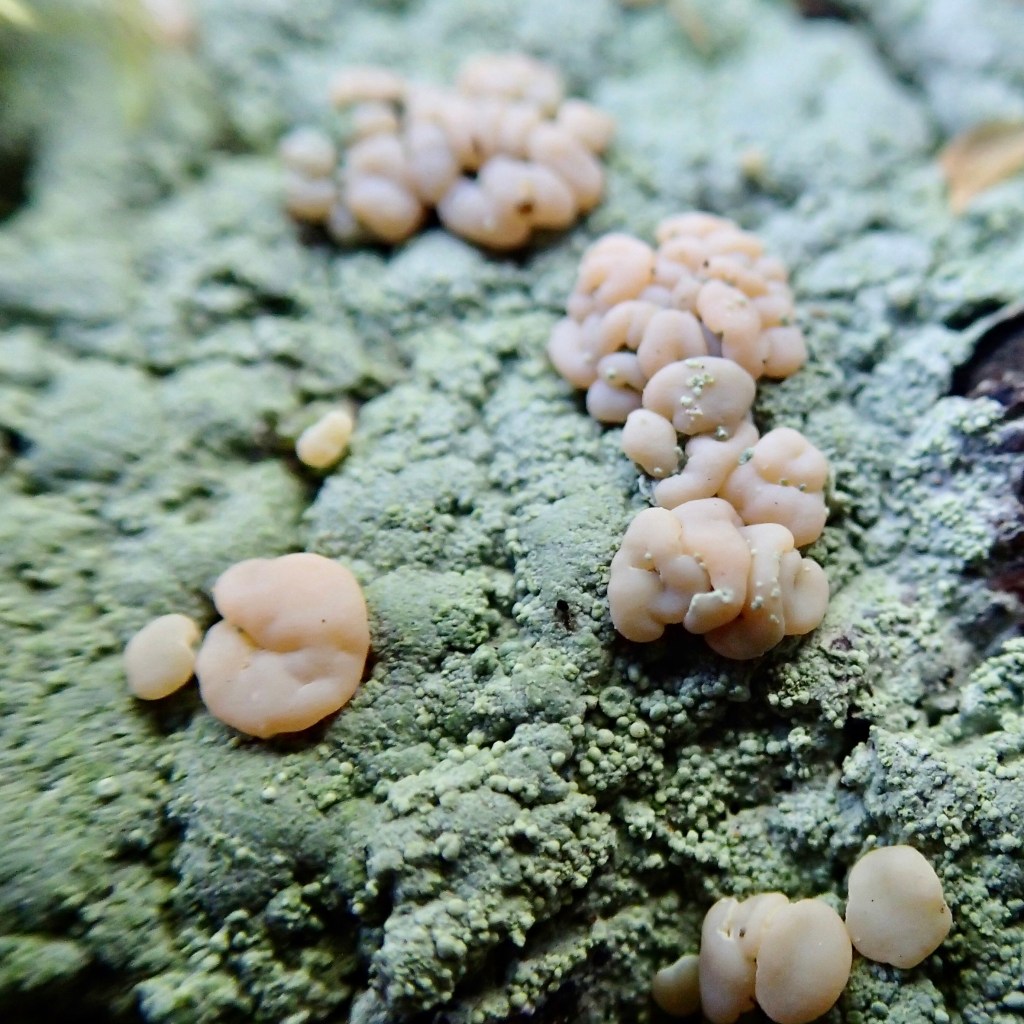
The return trail wandered through this forest thick with a diverse array of fungi which were just begging Tasia to cast her artist’s eye to memorialize them in our travel blog.
This trail, the Falls and Lake Trail, offered a more diverse landscape with views of the Tanalian River, tranquil ponds, Tanalian Mountain, and a panoramic view of our lodge in the distance.
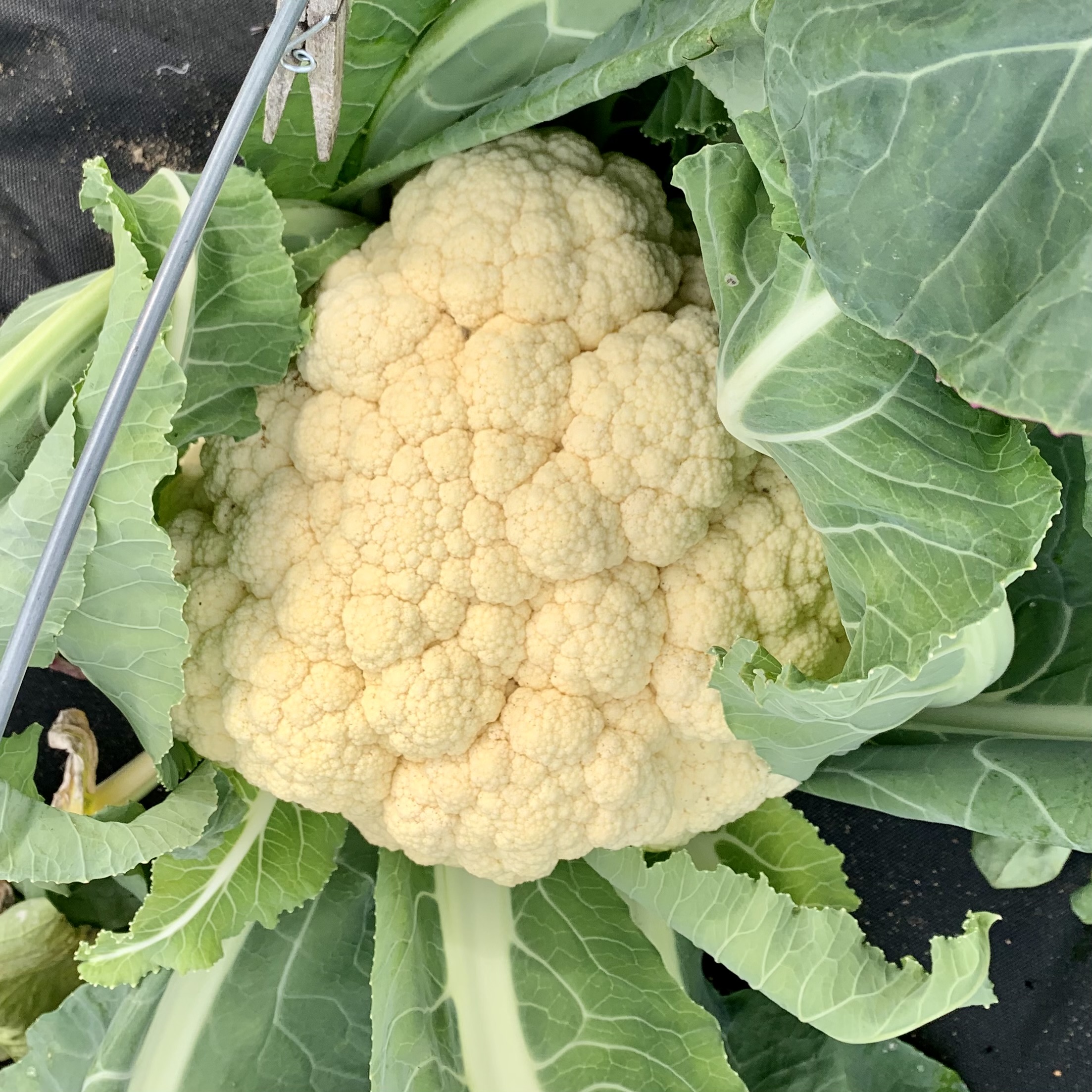
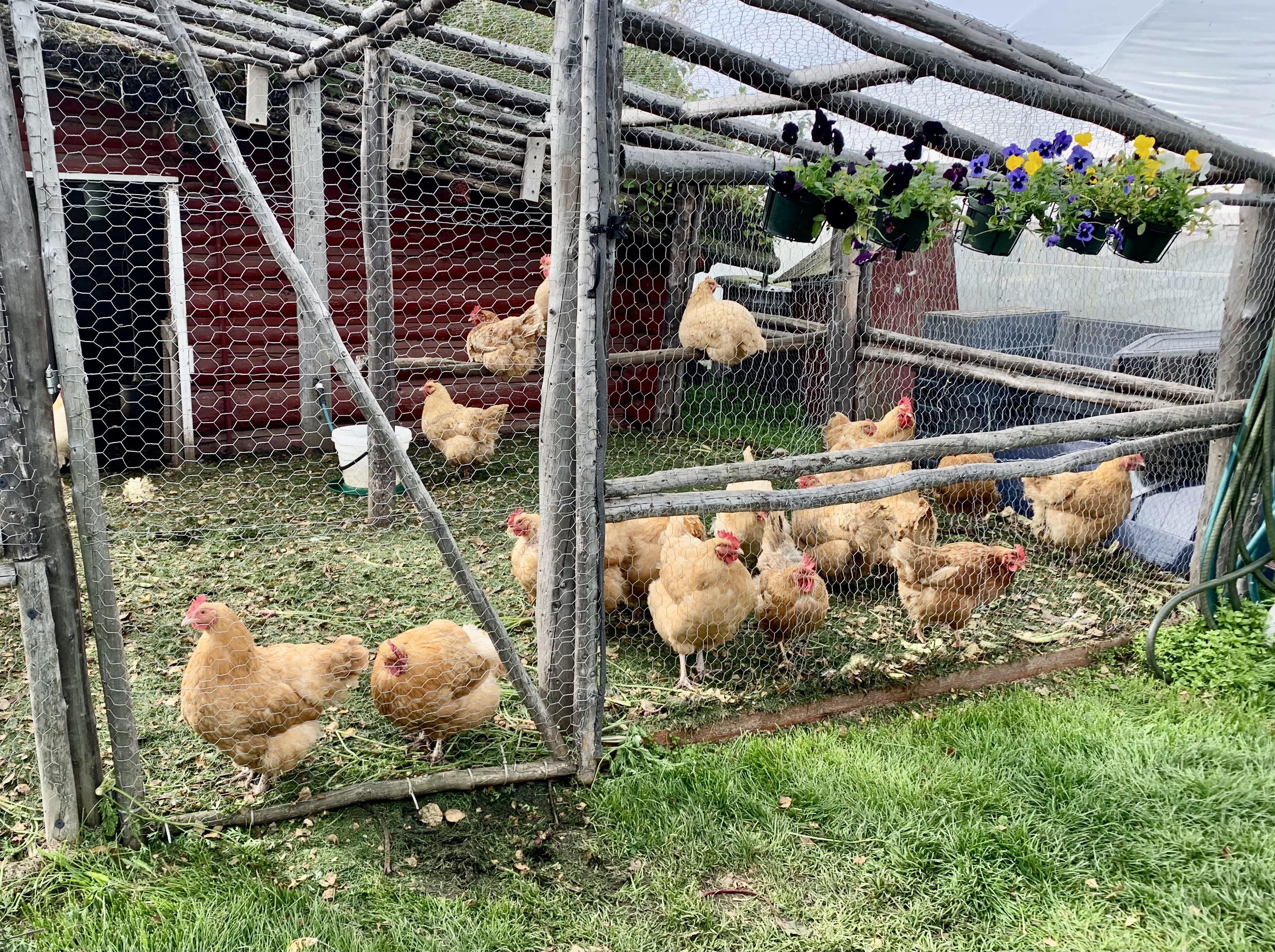
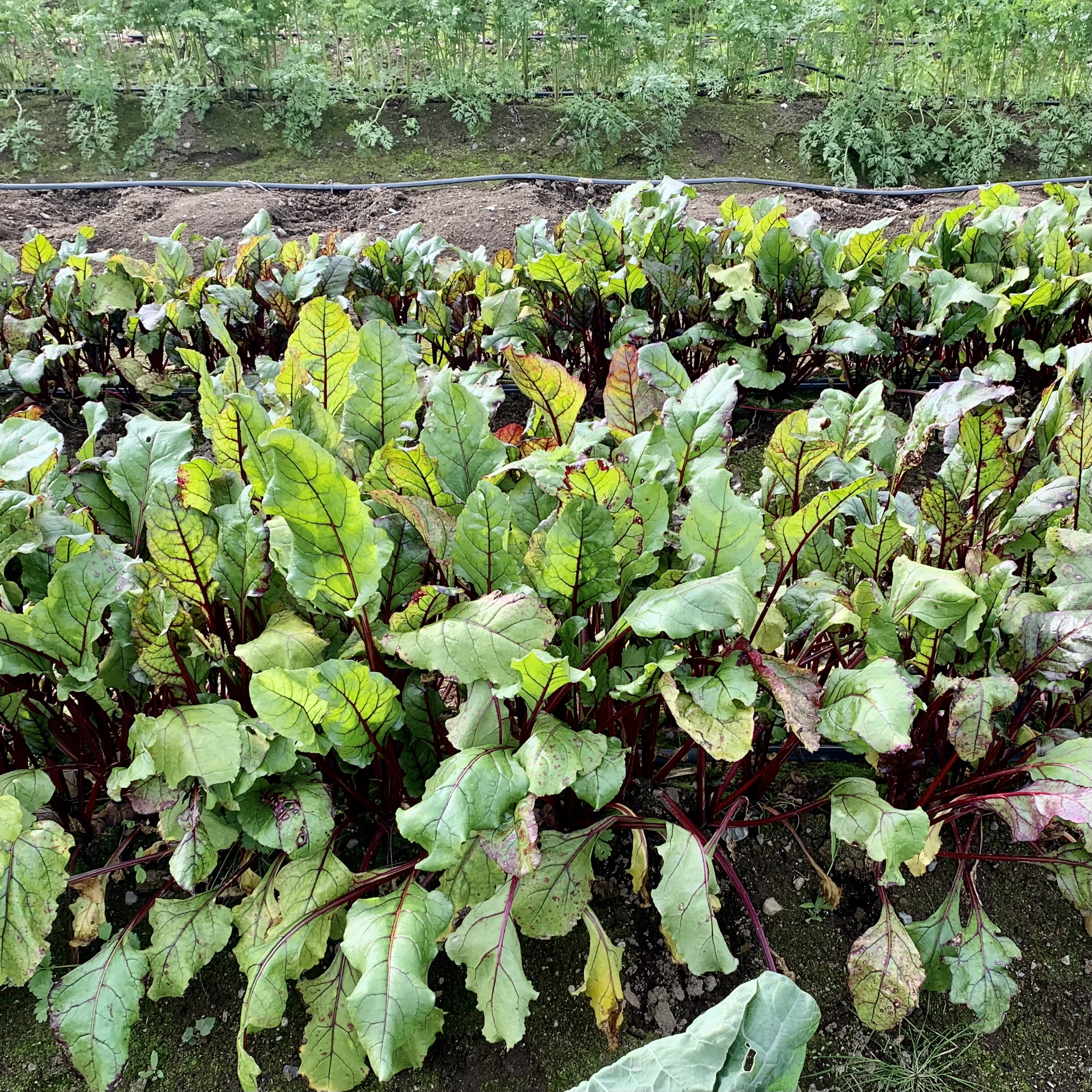
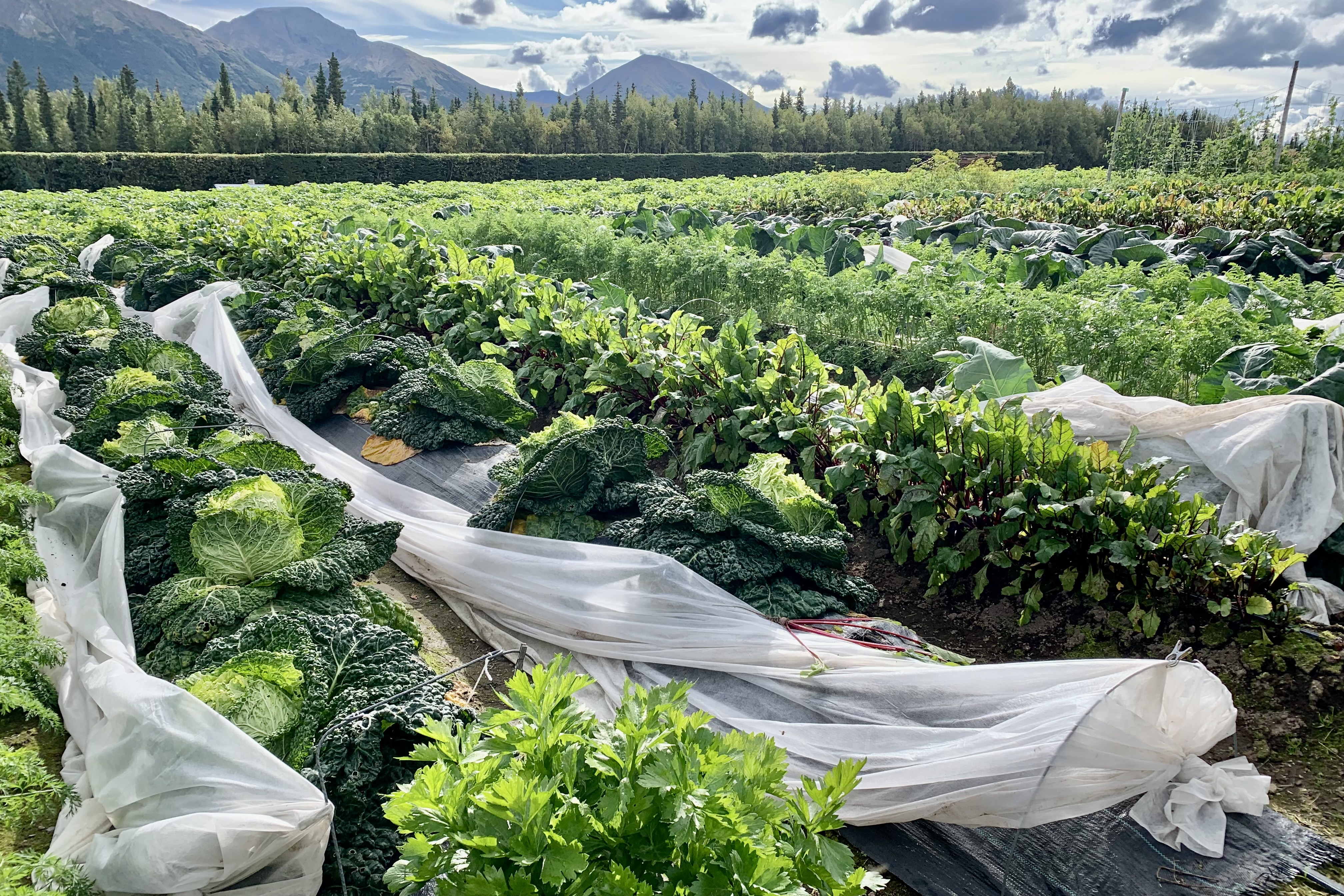
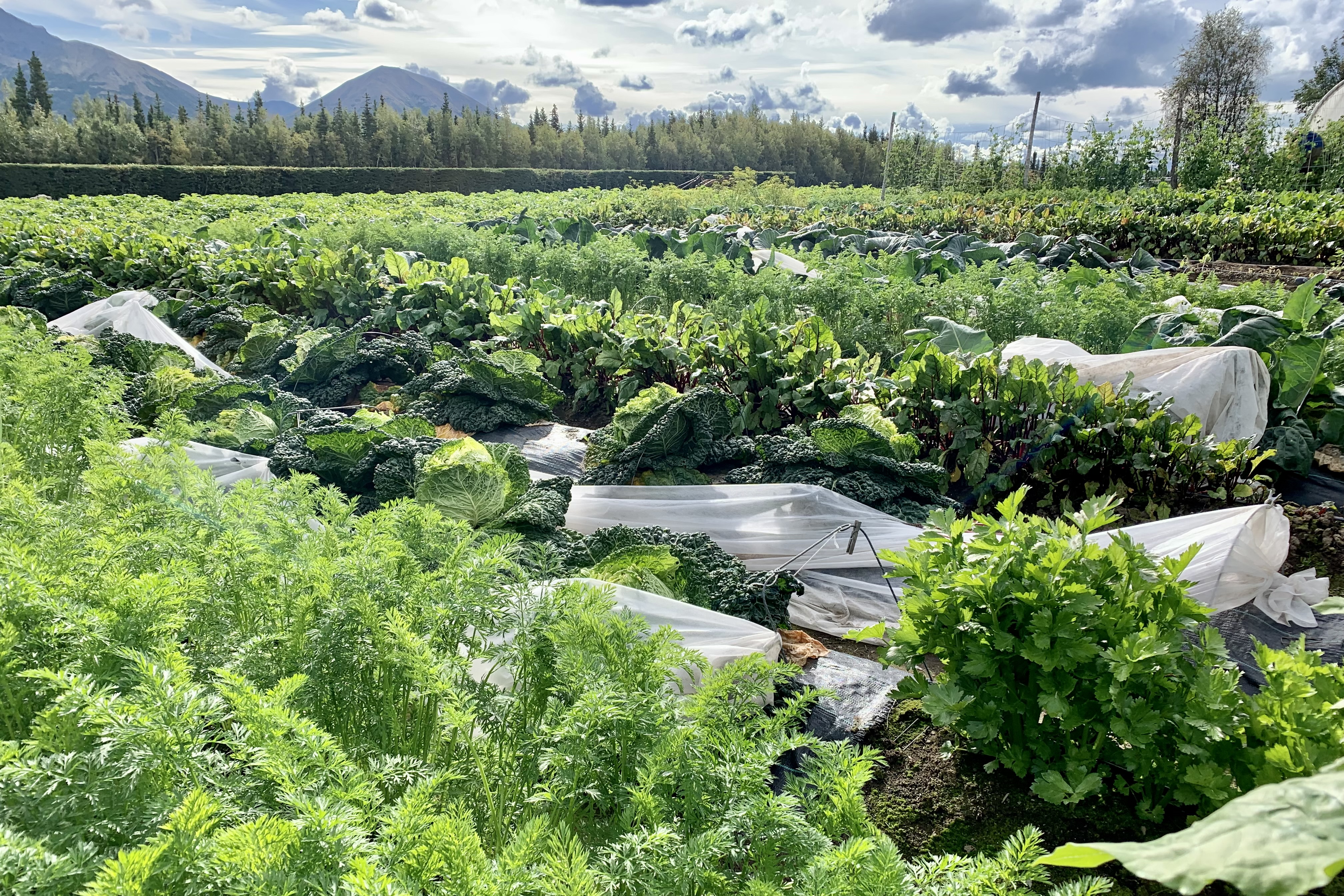
Once back at Lake Clark Farm Lodge, I decided a tour through the “farm” area was in order as I hadn’t yet taken the time to explore this “working farm” with it’s vegetable garden. From a distance it appeared quite impressive. We had been enjoying wonderful salads and fresh vegetable at every dinner from the garden . The vegetables in the garden were a la Alaska style. Alaska typically has a very short summer growing season, only 105 days, on average. Despite this short summer growing season, Alaska farmers have the advantage of the midnight sun enjoying as much as 20 hours a day of sunlight during the summer months. The vegetables love it but without blackout curtains sleeping in the midnight sun for a human can be challenging. The extra hours of sunlight allows Alaskan crops to just bask in the sun and keep growing and growing because of a longer photosynthesis window each day, resulting in bigger sweeter produce. There were hardier crops such as potatoes, cabbage, kale and cauliflower in large plots outside and the less hardy in in the green houses. Every evening I watched the gardeners covering rows and rows of some of the plants but not all. I came to find out that, what I assumed was an attempt to protect them from the colder night air or possibly insects, was to actually keep the moose from having an evening feast or big old garden party. Additionally there were fresh egg options at breakfast from the resident chickens in the hen dominated coop though there was one strutting rooster maintaining order and establishing the pecking order .

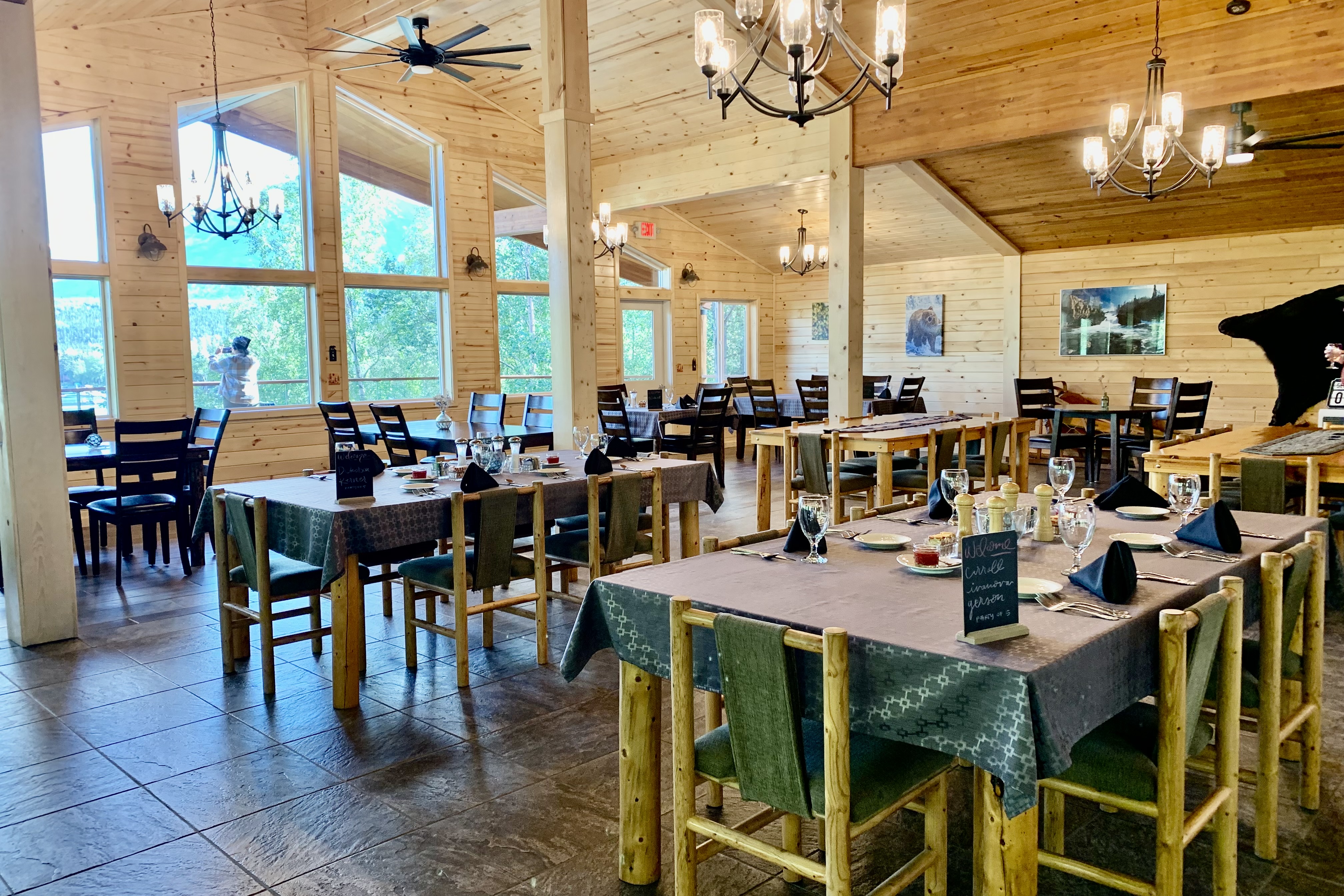
Soon it was time for our evening meal. Home cooked meals at the Farm Lodge were served in the main lodge family style at a an appointed time daily and were excellent.. The family cooks prepared exceptional breakfasts and dinners and very tasty sack lunches to go. I thought the food was truly gourmet and I marveled at how they could have a 5 star dinner in such a remote area! Portions were huge and our dinner meals included fresh baked breads, farm-to-table fresh vegetables, homemade deserts along with the overly generous entrees. We order our breakfast and lunches from a multiple option menu at dinner. When I first learned that seating would be family style at large tables of 8 and we should look for our place cards, I was a bit off-put. I really prefer not to be “told” who I have to socialize with. But I soon mellowed to the process at is did allow for interesting conversations with other guests. And there was a lot of commonality amongst this group that would opt for this type of trip.
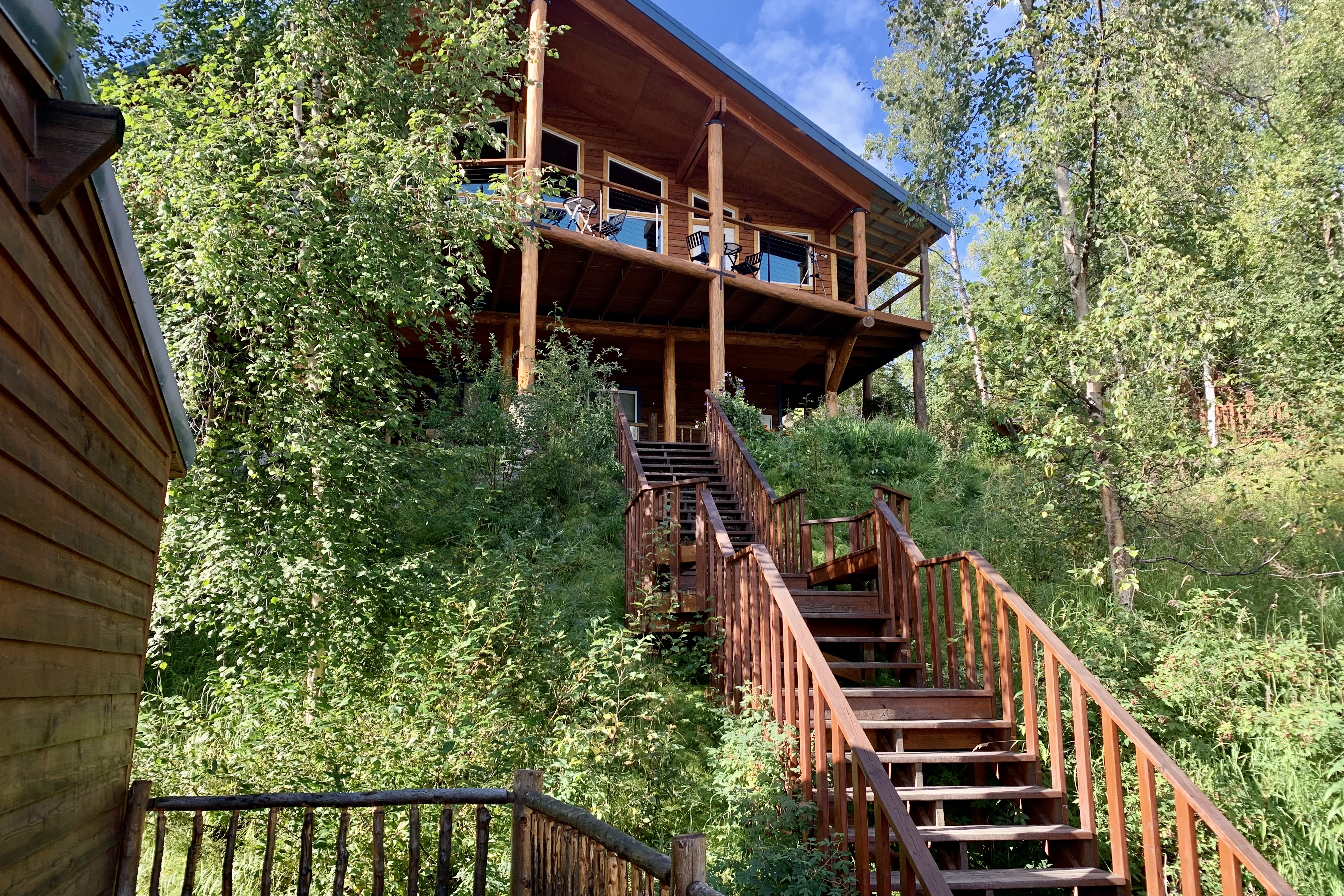
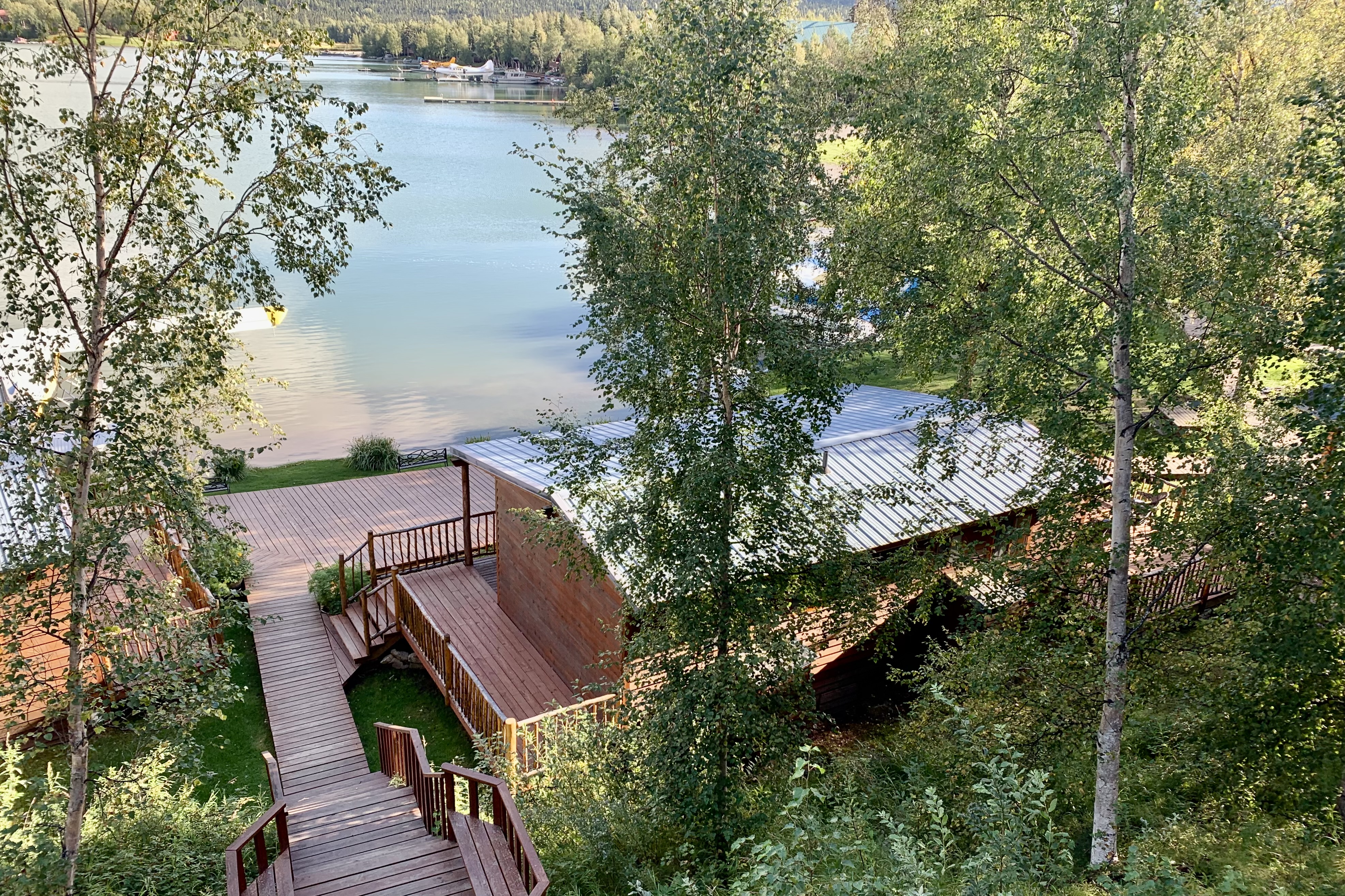
The accommodations were relatively modern for Alaska Our guest cabins was heated (definitely a necessity at this time of year), had a private bathrooms with running water. (yes this is important to note when booking a cabin in Alaska), a covered porche for relaxing, AND was on the waterfront.

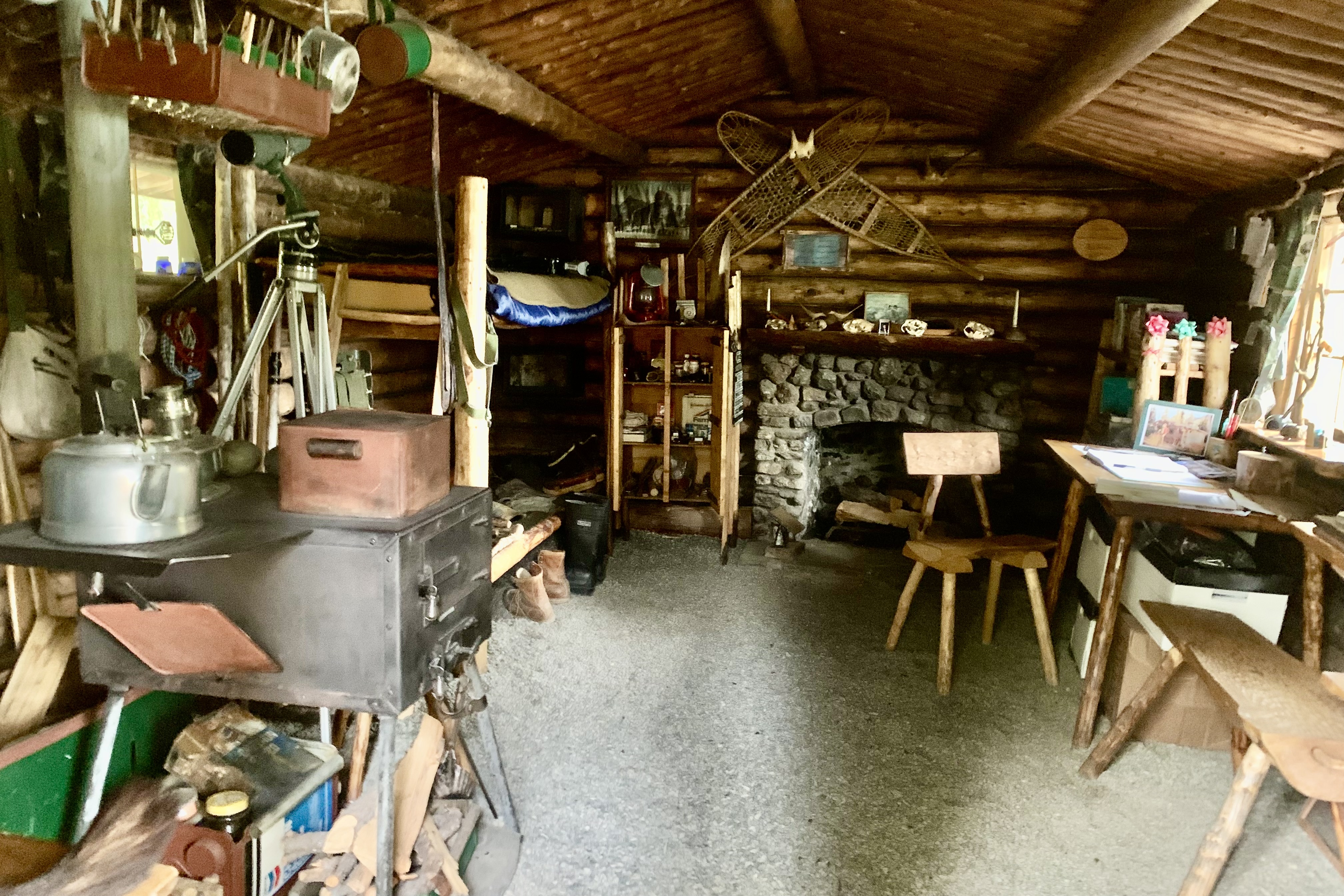
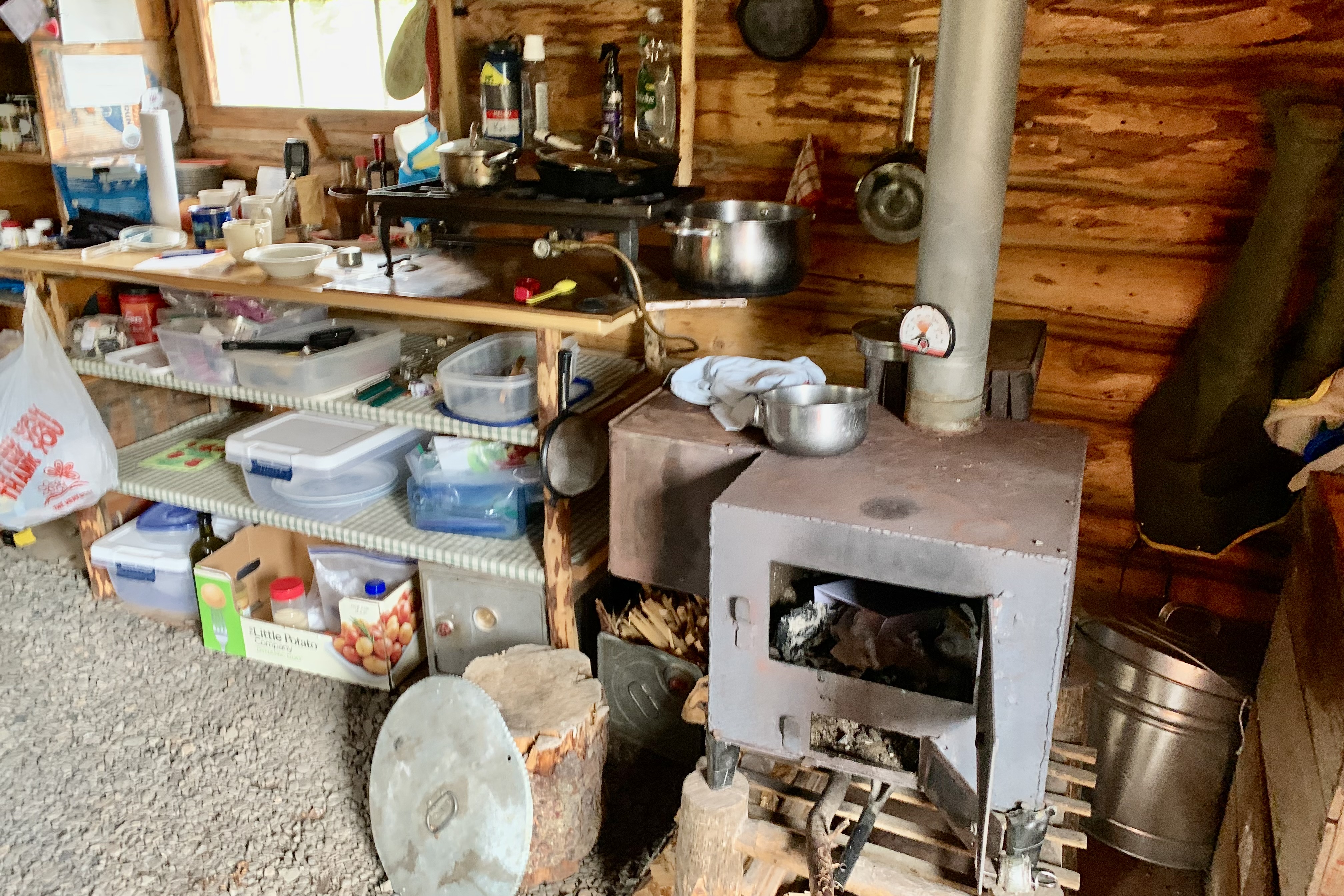
For our final full day we hopped back into our float plane to try again a landing at the Upper Twin Lakes and the opportunity to visit Richard Proenneke’s wilderness cabin. There had been a dusting of snow on the mountains we flew over that were not snowcapped the day before, reminding me that winter was fast approaching in Alaska. I was pleased to have finished reading One Man’s Wilderness the previous evening and was so grateful to have read it as it really gave me a glimpse of this arduous enterprise that he had undertaken and what was involved in building this very rustic home. The entire structure was built purely with materials on hand: gravel retrieved from the lake bed, felled and hand worked timbers, and stones dug from around the site for use in his chimney and hearth.
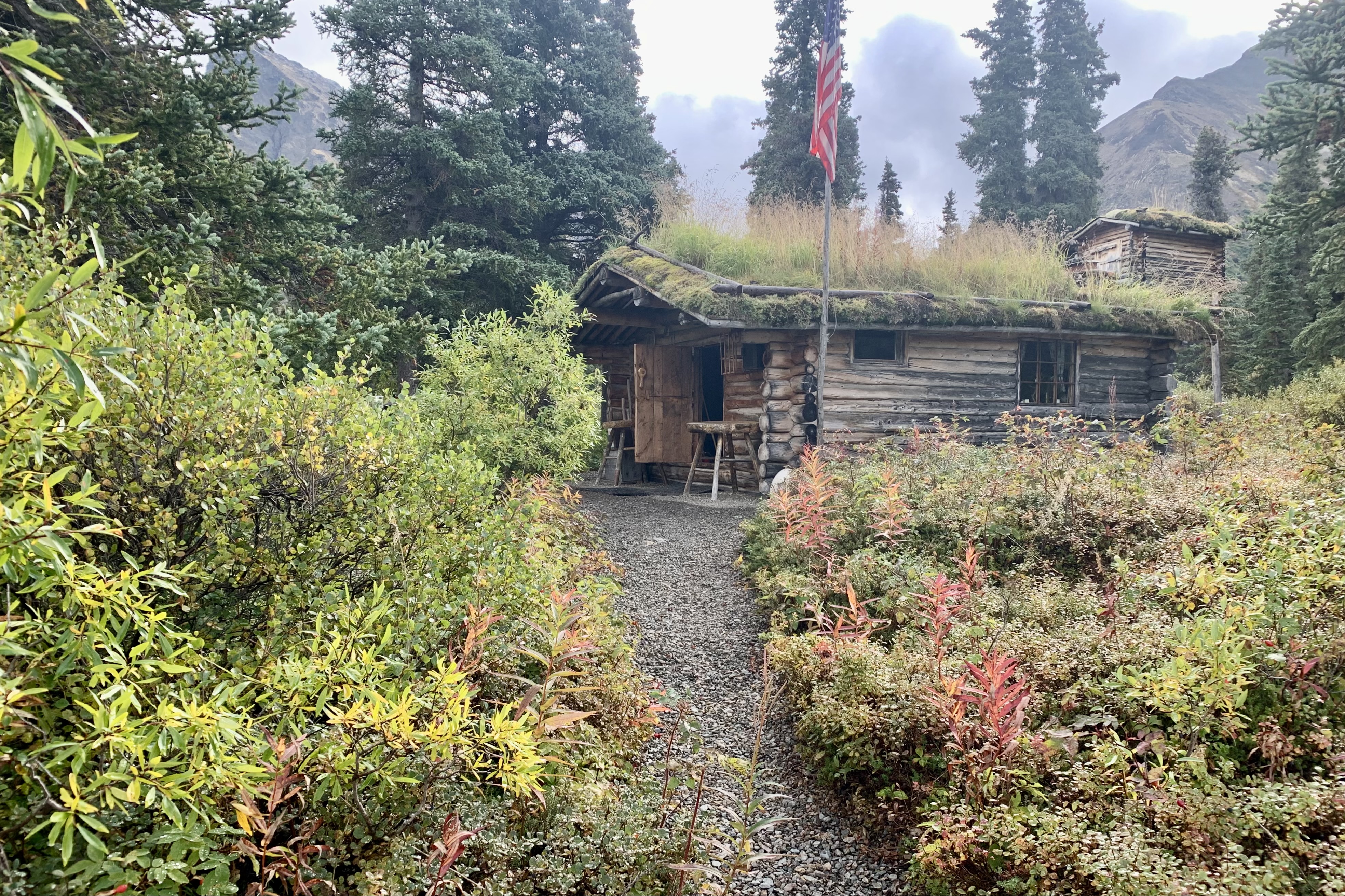
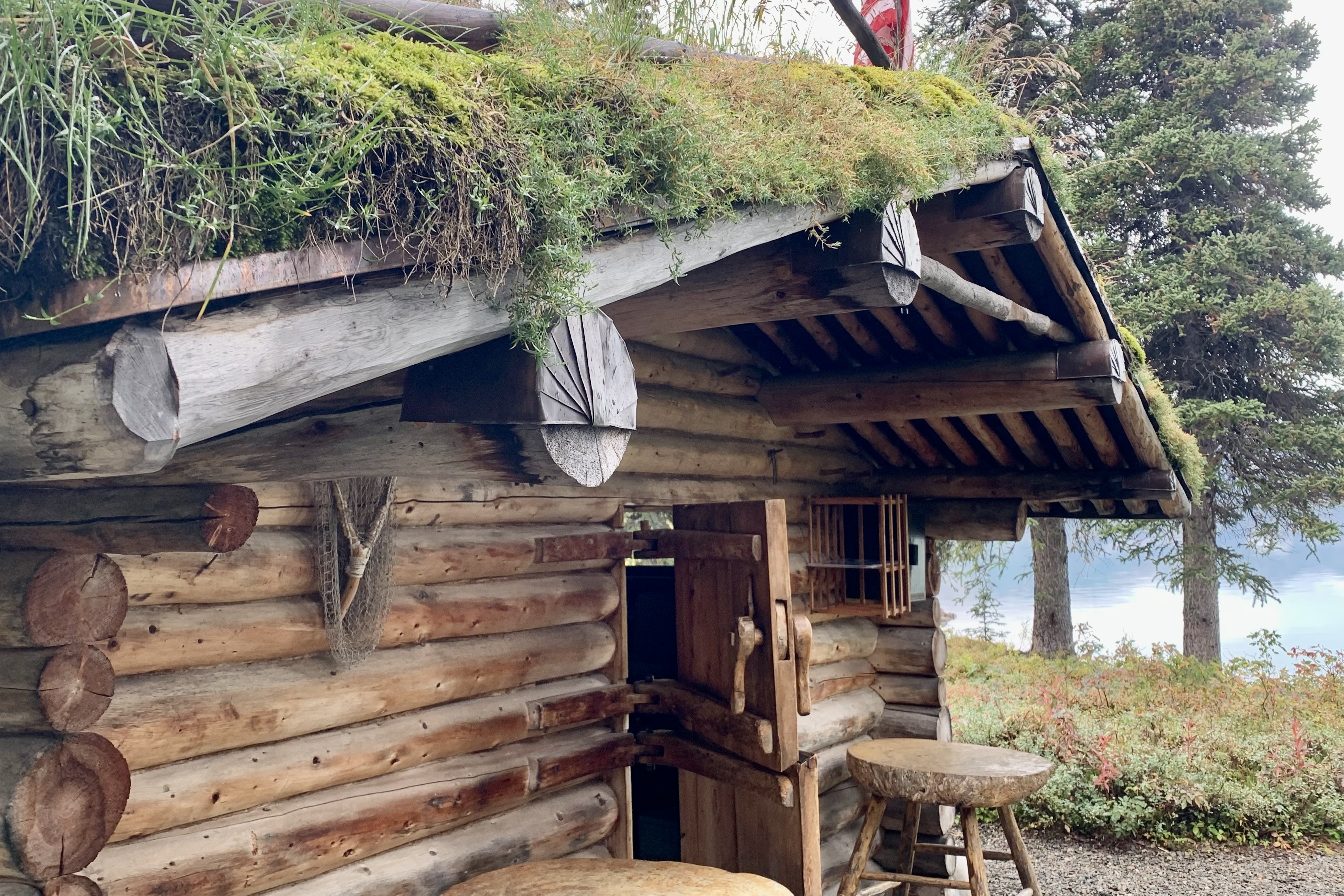
Visits are guided through the cabin and grounds by two National Park Service summer volunteers who live on the property. What I hadn’t thought about then was how tough these two women had to be to live in this remote wilderness area, out there with the bears, with few trips back to the civilization of Port Ellsworth during their stint. Now if I were ever to consider volunteering at a National Park this would be one of my first choices. I have no interest in living in a campground in a park in a monster RV with its satellite dish and every convenience of home. Here the volunteers are provided with NPS accommodations as they could not stay in Dick’s “luxurious accommodation” but in cabins nearby, one of which was the homes of his associate and friend Spike Carrithers. Any of my readers game for staying in this “woodsy forest retreat” as a volunteer next season??

The following morning after our last made-to-order sumptuous breakfast, we boarded a Piper PA-31-350 Chieftain, with wheels not floats! This plane is no spring chicken since this model was built from 1973-1984 thus probably between 40-and 50 years old. I know nothing about aging planes but I trusted they have a good long life-span and someone has taken care of their health. The flight took us back through the Lake Clark Pass with one final spectacular view of the Chigmit Mountains and the Cook Inlet. After retrieving my car I dropped Tasia at the Ted Stevens International Airport and was on my way up to Talkeetna AK for Phase II of probably my last great Alaskan adventure.
Conk, Weeping Skies, and Fish in the Tree Tops

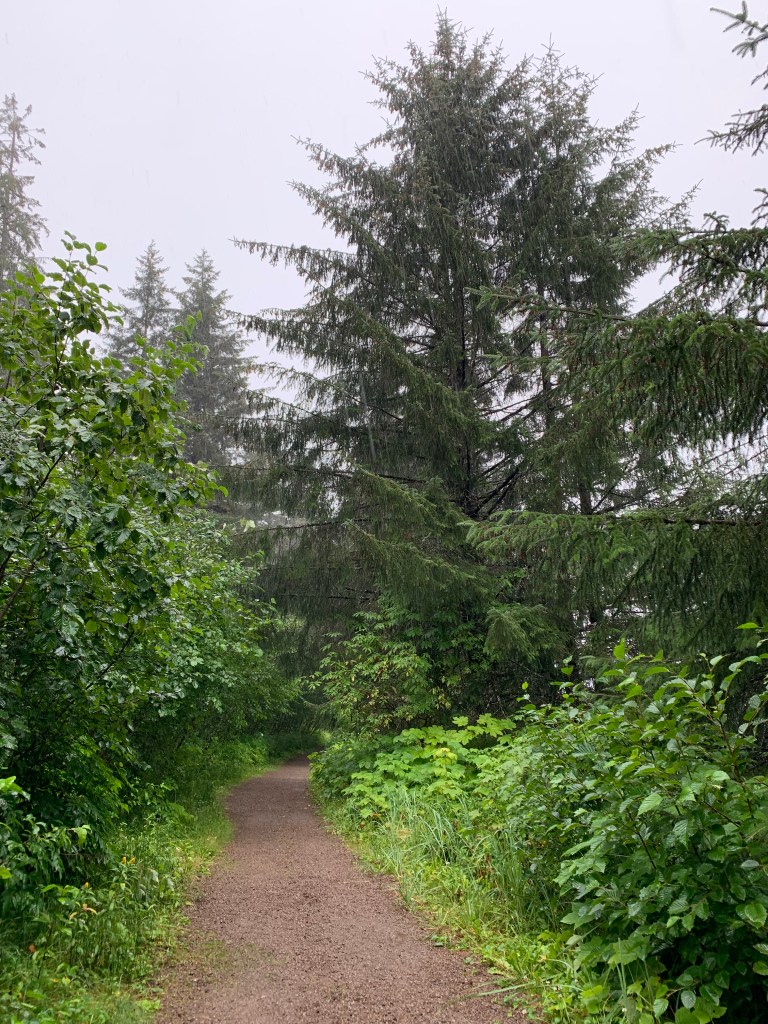
I was determined to do a decent hike so day three became the Bartlett River Trail day. I was absolutely NOT astounded when I  parted the curtains upon arising to discover there was a steady stream of wet projectiles descending upon  the already drenched soil of Glacier Bay. I said to myself: “How fortunate  you are Theo to be able to experience the Bartlett River Trail in this temperate rain forest during a day when a rain forest  is doing what it does best. RAIN, RAIN, RAIN.” And that it did for the entire 5.88 miles and  4 hours and 20 minutes I slogged on through this.

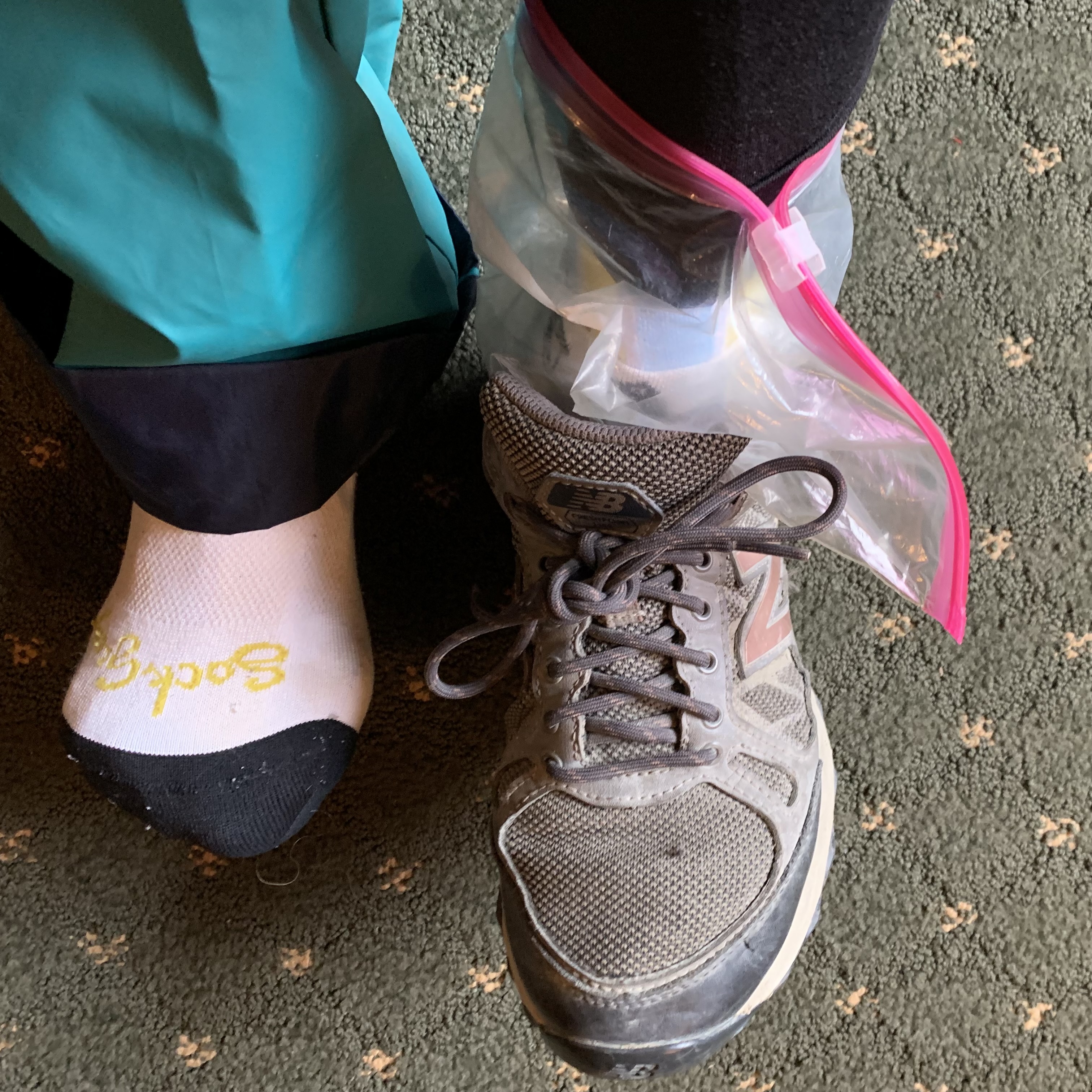
Now I was well dressed, I thought. I would keep my feet dry by putting plastic bags over my double socks in my trail shoes. However the zip-lock variety was all I had available, so they would have to do. I had a base layer of light weight polyester underwear under my hiking pants which were under my 15 year old rain pants. My top was layered with polyester under shirt, a long sleeve t-shirt, a shell vest, and my bright pink flannel lined rain jacket which I had patched the hole in it with silver tape. I had a visor hat to keep the rain out of my eyes. My daypack was not waterproof but I put everything in a plastic bag inside of it, including snacks, extra clothing, a warm cap and gloves. I headed out with the spirit of adventure, feeling a bit mummified given how thickly I had wrapped myself, but was grateful at least today I wasn’t carrying a heavy backpack or returning to a tent.

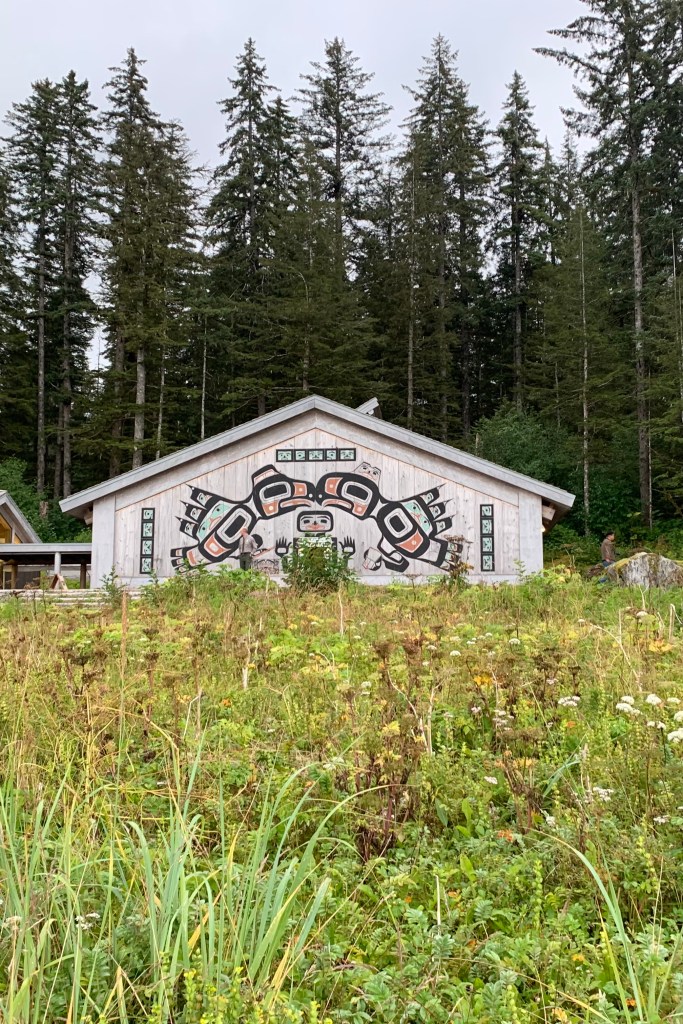
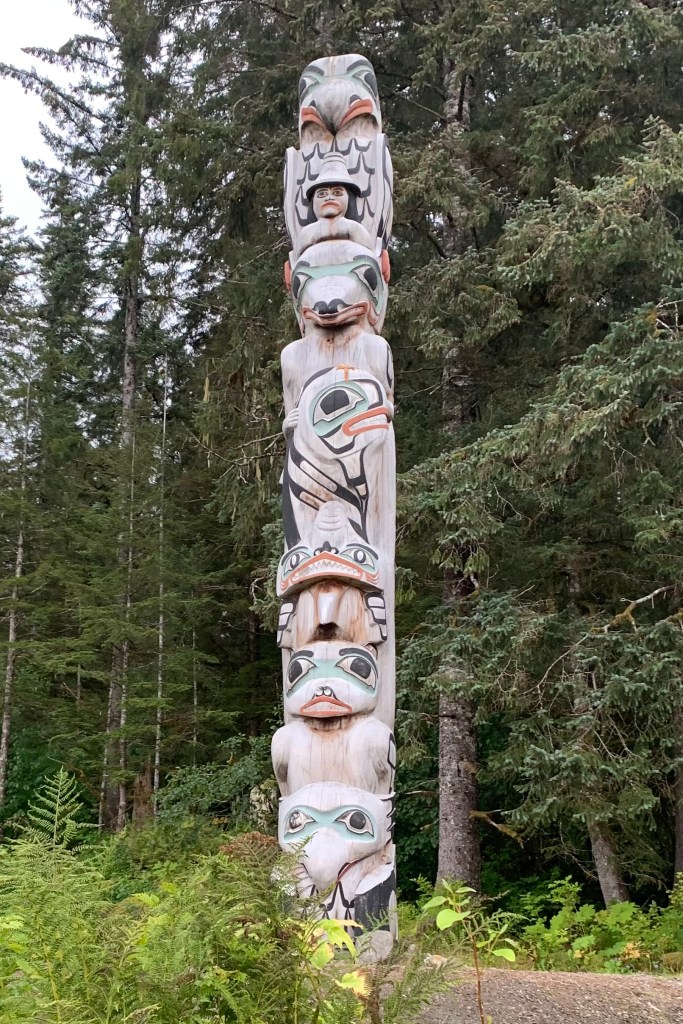
To reach the Bartlett River Trail,  I hiked out via Tlingit Trail. This was a easy stroll on a well maintained gravel path along the shoreline passing the Tlingit Tribal House and Raven and Eagle totems..

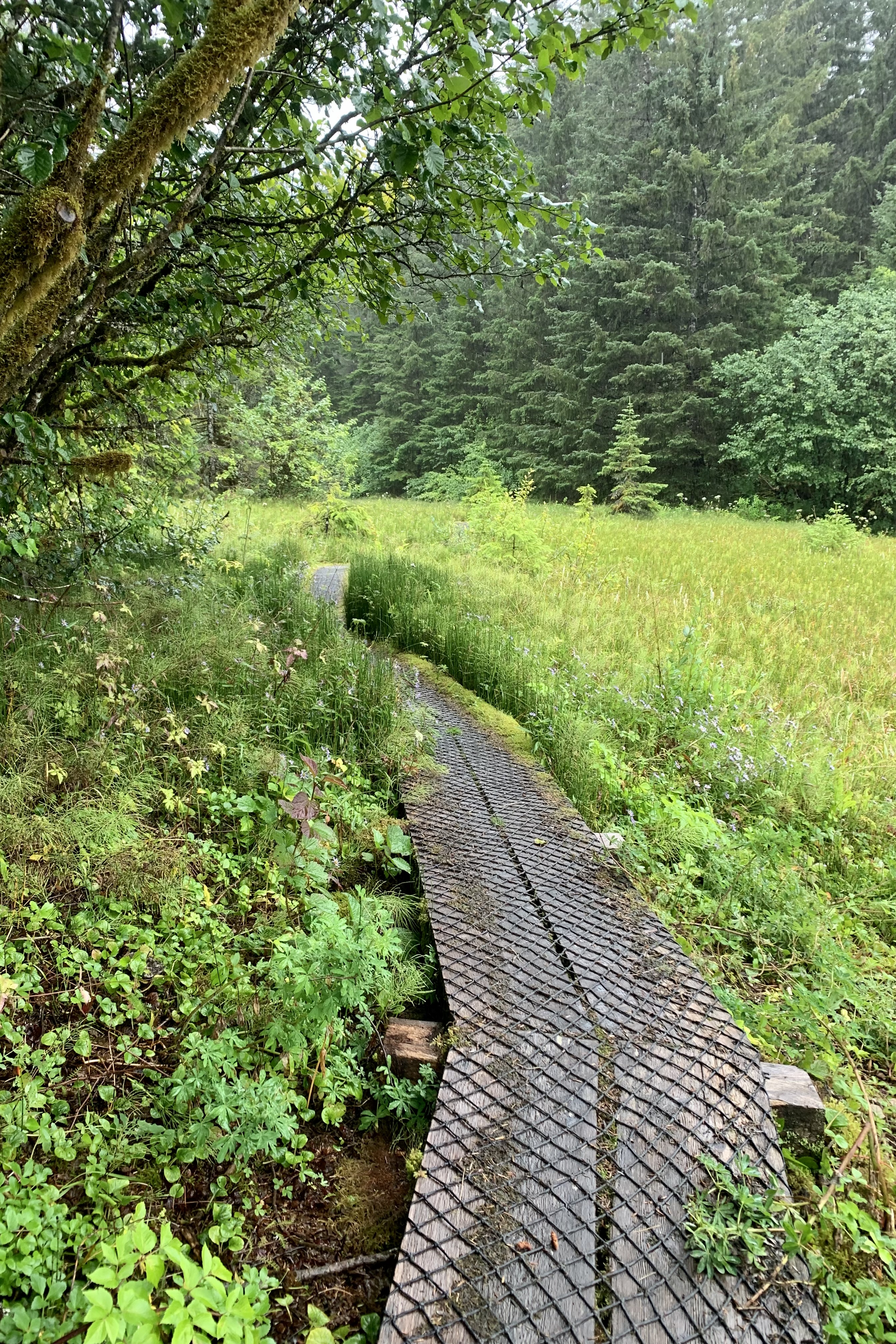
 Upon reaching the trail head, my l intention was to hike the 8 mile round trip trail to Bartlett Lake.  I merrily (though that feeling stayed only for a very brief moment) headed out but after the first half mile of jutting rocks, the complex webs of spruce roots, and puddles ankle deep, I knew it best to take the shorter Bartlett River Trail lest, at the pace I was moving forward, I would chance missing my plane the next afternoon and be charged an extra day for not checking out by noon. I really did not want to spend a night inhabiting the Tongass National Forest. This is a noteworthy choice since more often than not I do not make rational decisions. I prefer to be bullheaded and emotional and forge on. But I think that was probably the only reasonable decision of the day. By now I was also beginning to think that perhaps my solo jaunt into this wilderness wasn’t necessarily a wises choice since there were not throngs of hikers like the conga lines I experienced in Rocky Mountain National Park. Grasping at anything to validate my choice to continue solo, there was a group of about a 10 people headed out the trail to fish and there were in the first 1/2 mile two different couples returning from a much earlier morning hike. I concluded that perhaps this is after all a well traveled trail. I reasoned that if a root or a rock thwarted my forward momentum, I would not languish out there never to be found in this cell phone free wilderness. However , thereafter I saw nary a soul and might well have had to crawl out of this forest of dripping leaves and rotting trees should I turn an ankle or incur some other injury.

I had been  asked “aren’t you worried about bears ?” This is definitely bear territory.  Brown Bears (grizzly) occur in the Alaskan rainforest in densities that are unrivaled anywhere.  My thought process (probably convoluted thinking) was ”NO”  because this is the time of year when the salmon are plentiful and I imagine  that any bear would certainly prefer to be down by the water fattening up on those fresh salmon fillets, preparing  for their long winters sleep instead of foraging in the forest for a few measly low calorie berries and come upon me. Since I am writing this post hike, you already, I am sure,  have assumed that I neither got attacked by a grizzly  nor did I fall prey to the raised root and tripping rock hazards with my broken body needing  to be carried out and languish in a hospital.
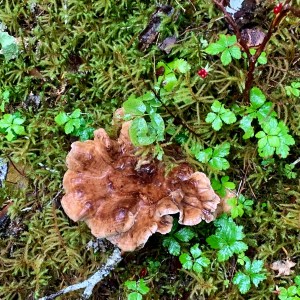
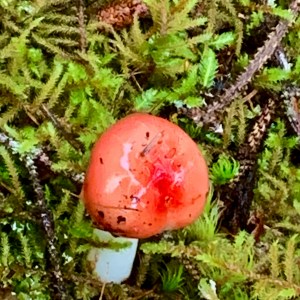
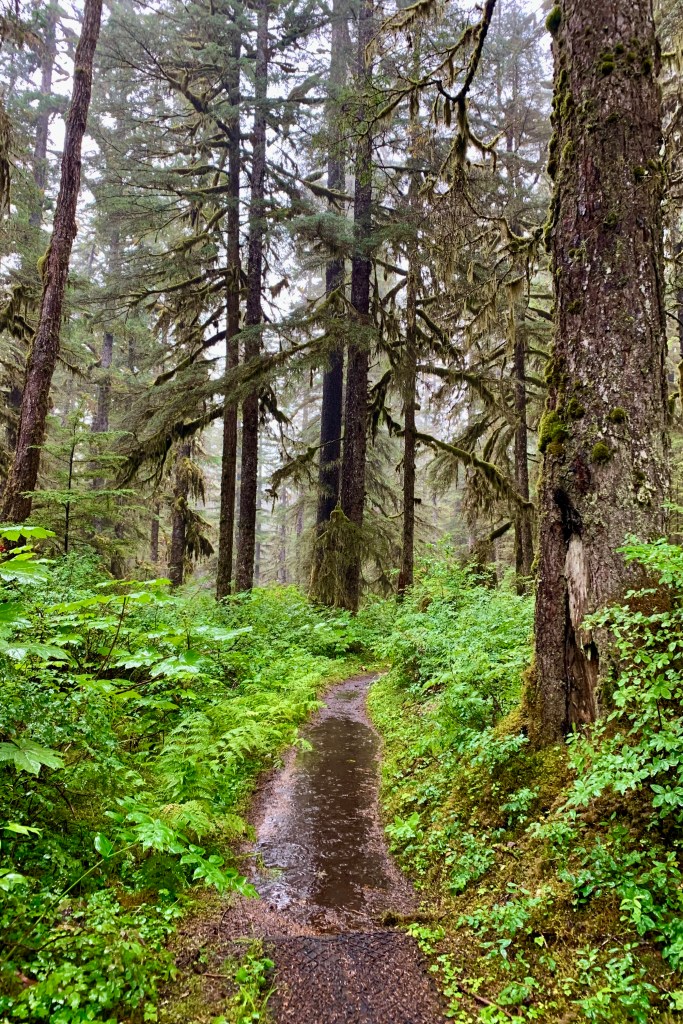
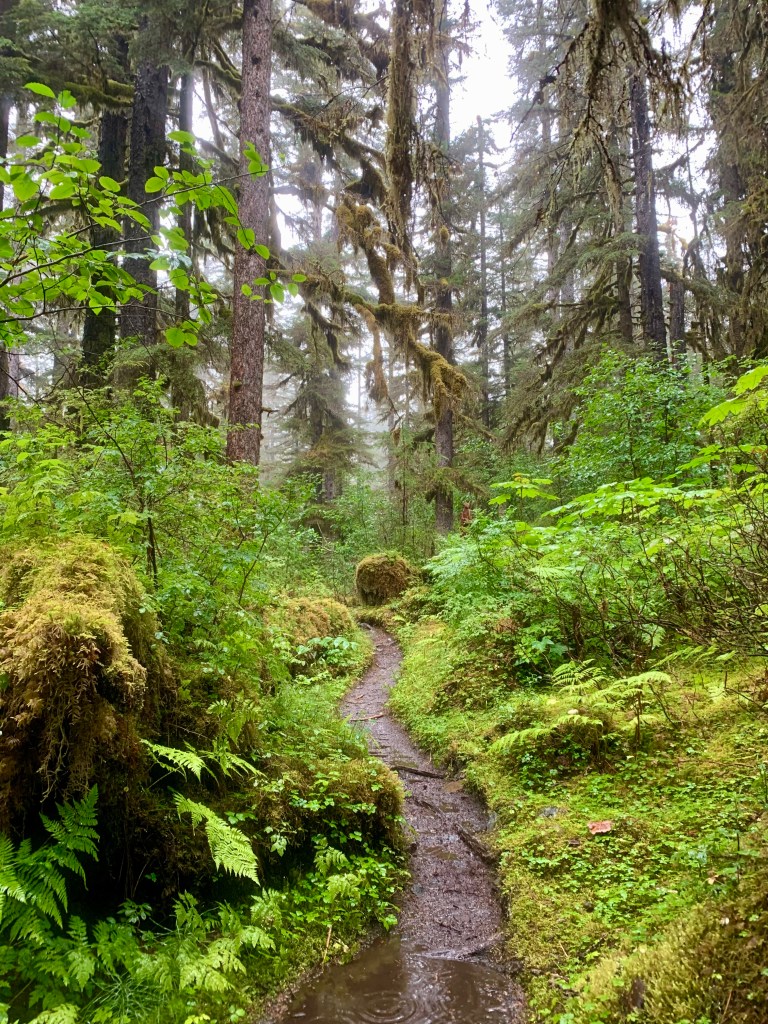
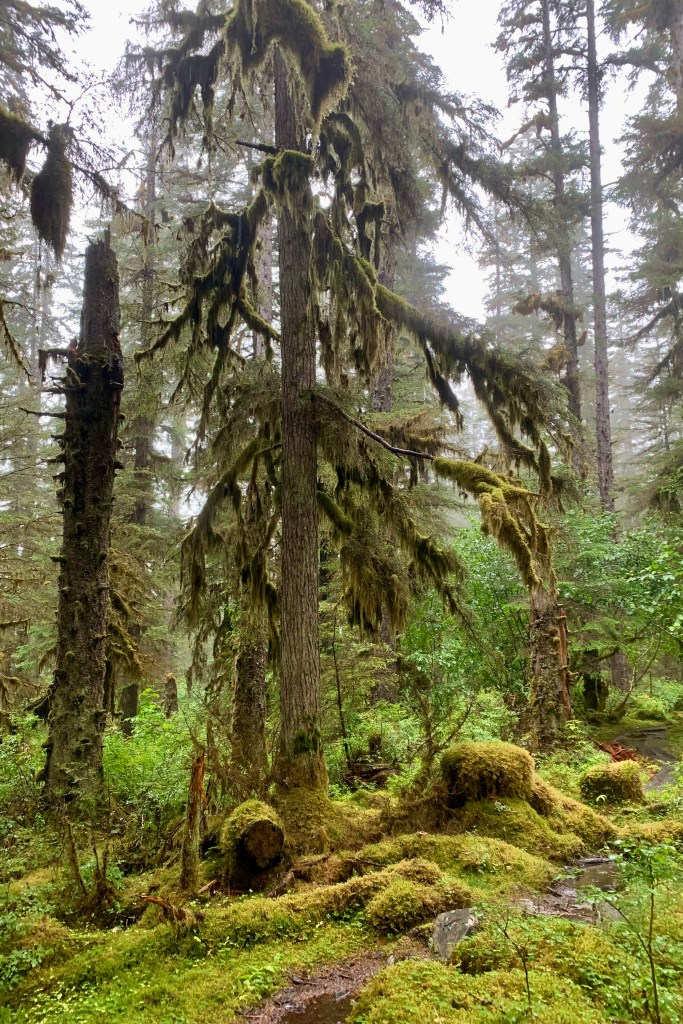
Actually hiking in this  rain forest was a truly amazing experience in so many ways. Think about the herbaceous vegetation, under an old growth canopy of tall old coniferous trees, that one witnesses on the forest floor: the humus, understory of mosses, mushrooms, fungi, lichen, ferns and some shrubs and berries.

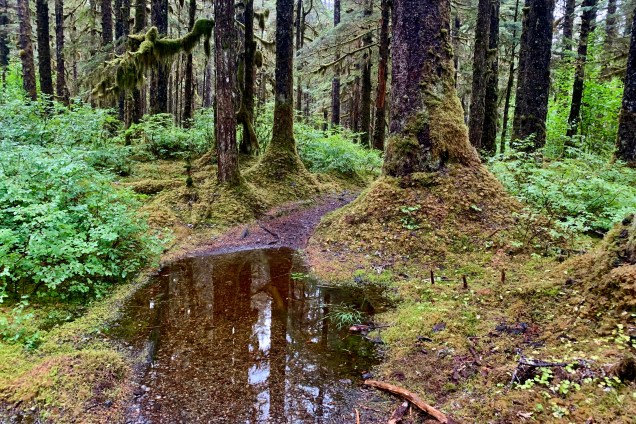
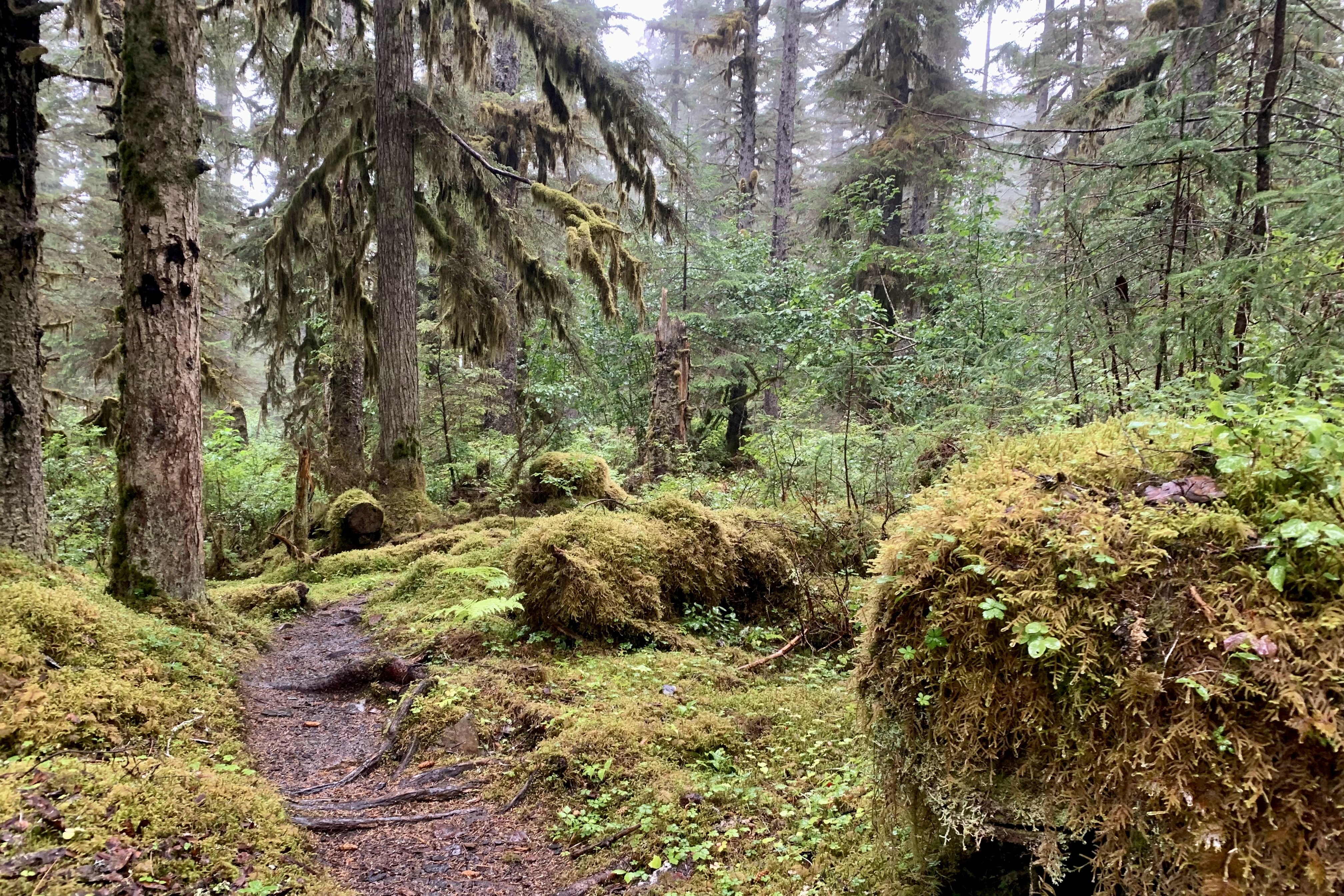
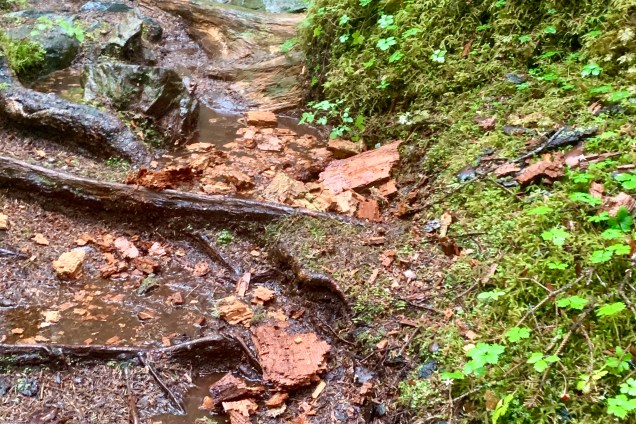
First it was amazingly  brutal for there were very few areas for each footfall in which there were not entwined roots, rocks, moss, algae, slick mud, and waterholes to pick my way through. Now for the fleet of foot this would not be as daunting but for an older adult (who has already broken an ankle and a hip) with osteoporotic  bones it might not end too well should I pitch forward , sideways or even backwards when I got it in my head to leap, swagger,  prance,  flounce or trot  about through the mass of roots in this fairy forrest. So proceeding cautiously (which I am not know for), I at first took on the challenge of avoiding sloshing through  the puddles as much as possible  – an almost impossible  endeavor –  until I realized how absurd this was because I had the clear sensation of wet feet and assumed I now had very leaky plastic bag liners.

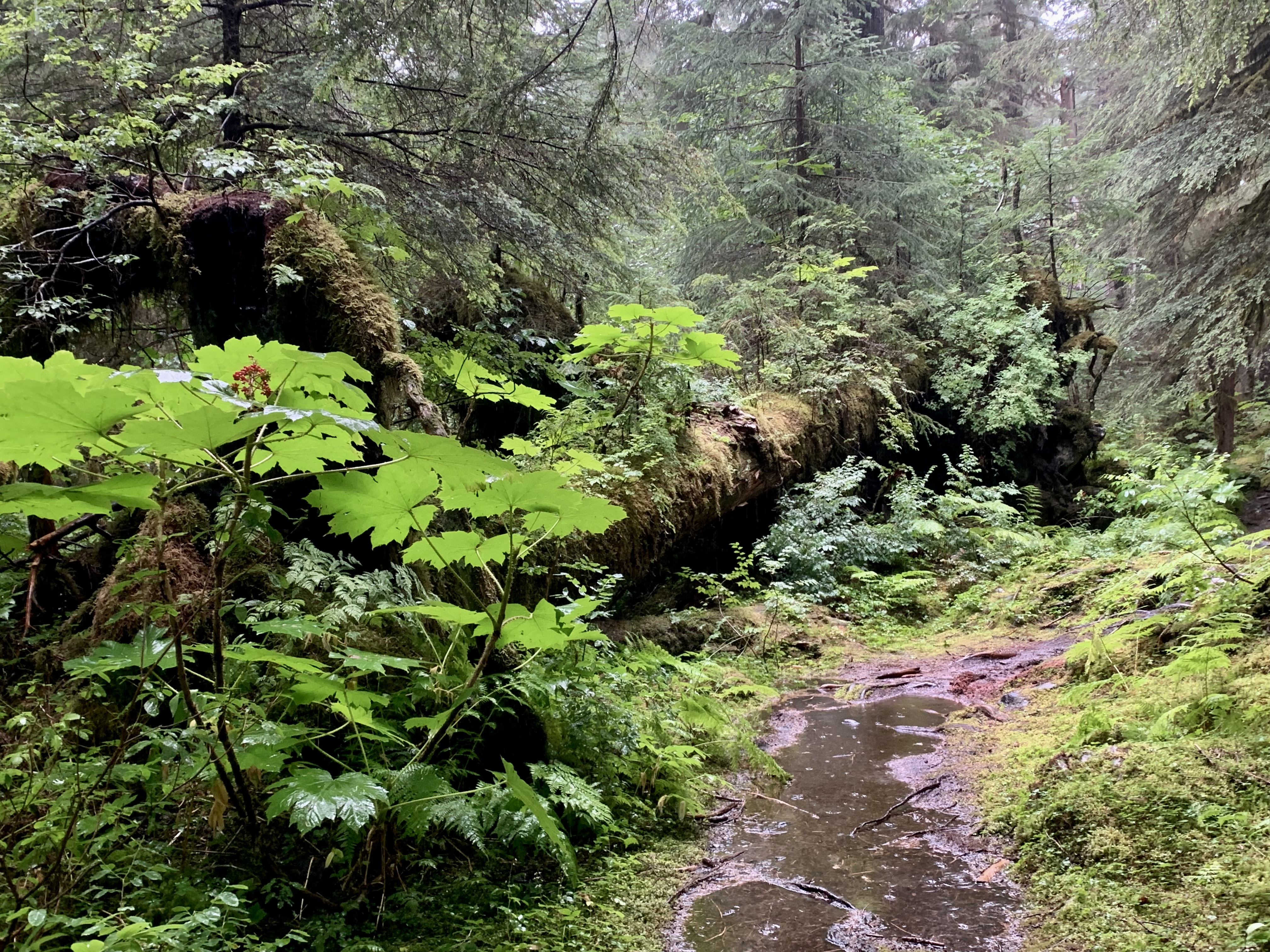
But by inching ahead so slowly I could begin to really appreciate the dramatic landscape that a rain forest is. The forest floor is covered with ferns and mosses, and epiphytes abound (mosses, lichens, ferns, and other plants that grow on other plants.) 

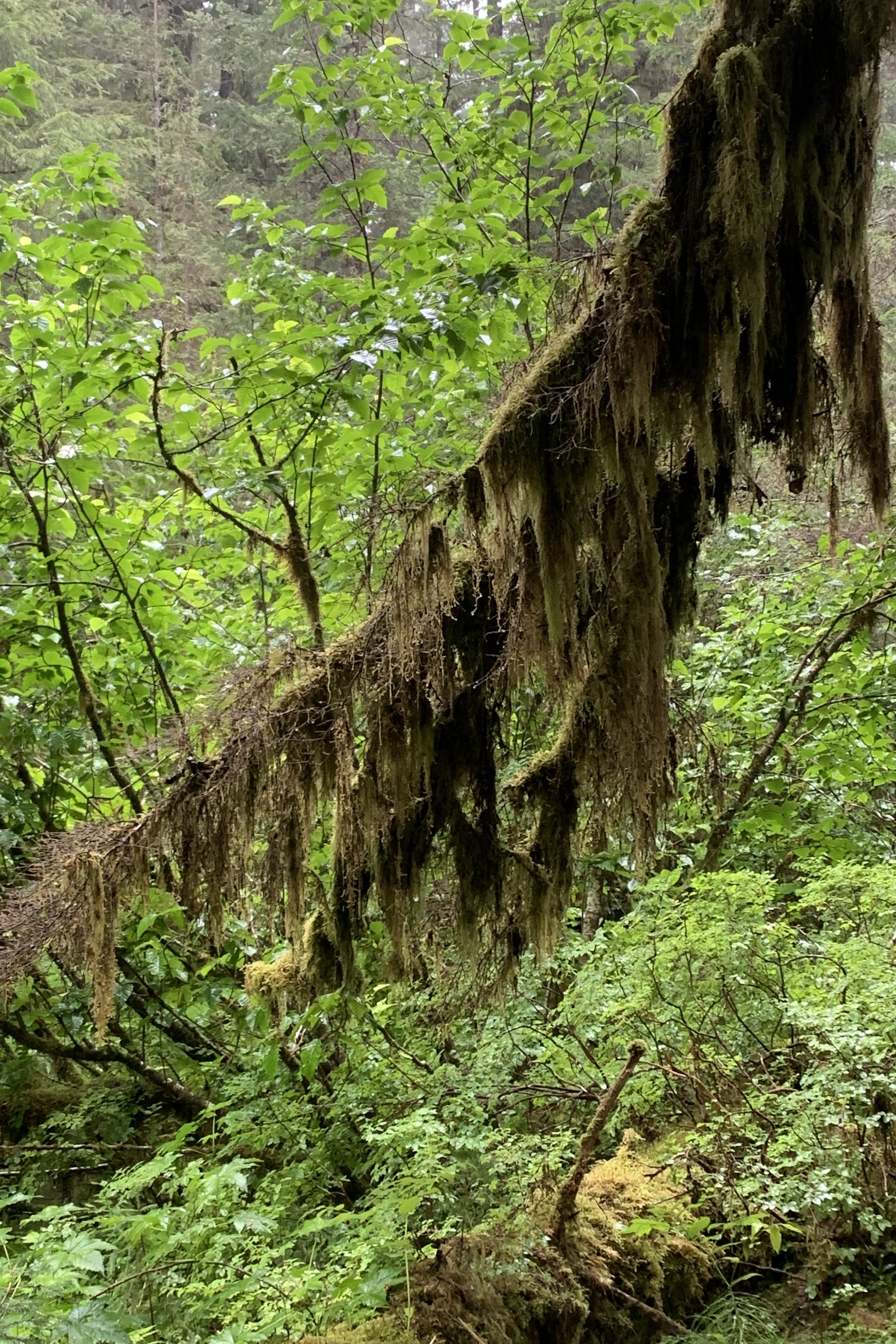
Mosses were every where crawling up the trunks and out on the limbs, hanging down from the branches,  hugging just about every surface, enveloping every stump, coating rocks, fingering ferns, carpeting the forest floor, sponging up nutrient and water, basting the bark of trees…these robust soggy mini-forests are lush pioneers that can just grow about anywhere in the rainforest and oft are the first to colonize an area.

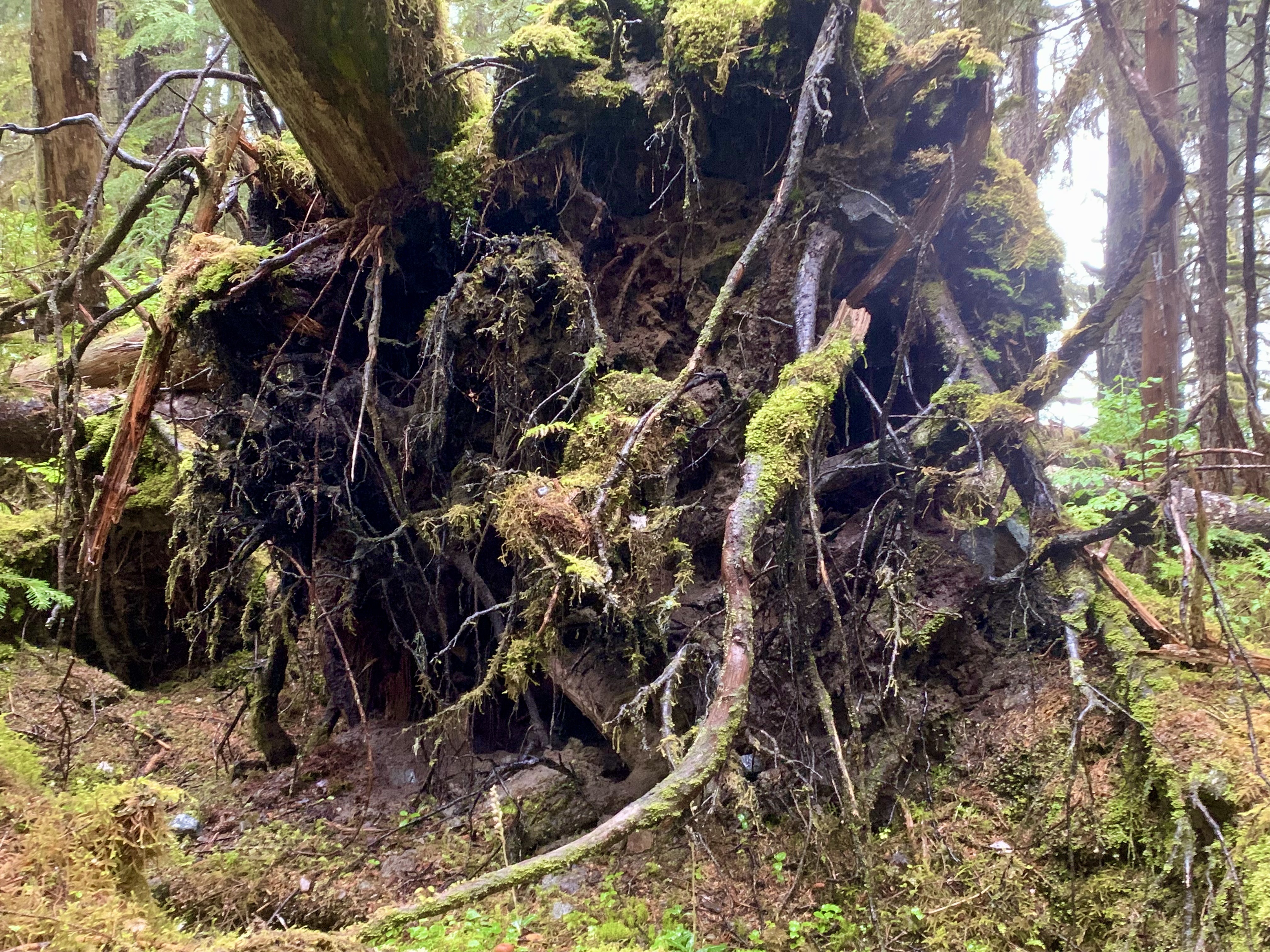
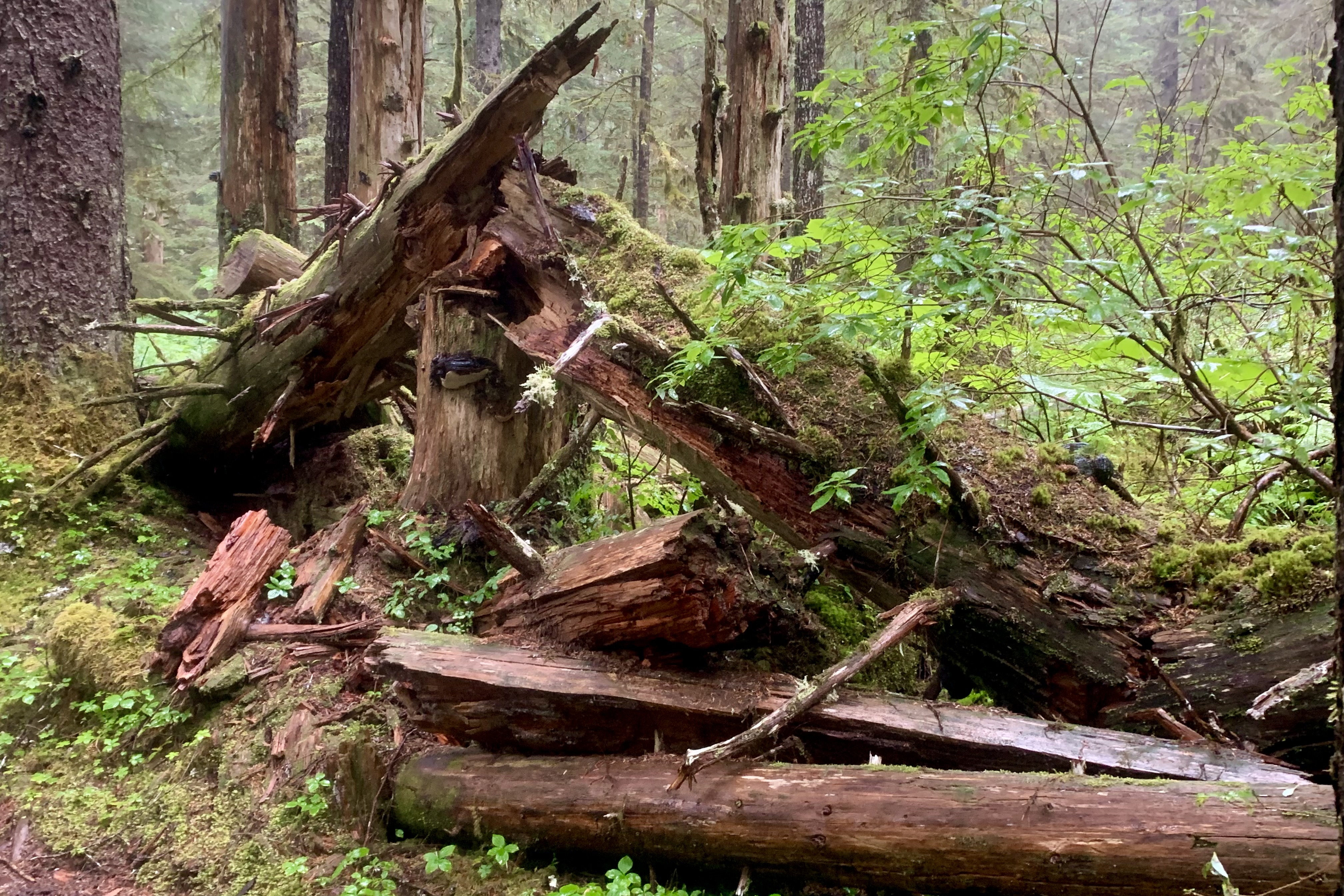
The root base of tipped trees I found eerily haunting. Because of shallow soils and high water tables, the roots of very tall trees  do not often extend deeper than 24 inches into the soil so they thus are particularly prone to tipping over during the windy and rainy fall season when soils are saturated. Stumps and downed trees proliferated and were rotting back into the ground or standing sentry in their green velvet coats. They seemed stalwart if doing their job of decaying and decomposing to provide feed for   the detritivore community.

I had read that fallen trees in a temperate rainforest are known as “nurse logs” because they provide shelter, nutrients and in some cases a platform on which young trees can grow.

I marveled at the myriad of stumps and logs raggedly rotting back into the ground. About one mile into the hike, I experienced a loud “thwunk” 6 inches in front of me. A good sized chunk of rotting wood from a tree above  had come barreling down and on impact exploded into chips fit for a good garden mulch. I was thanking that mysterious guardian angle of mine that it was not my head that got cracked and had I not tarried for a couple seconds at some point it most likely would have been. This did give me pause to think about this other unforeseen danger hiking in this weeping rainforest. In fact this rainforest was totally distraught and sobbing heavily. But not to be derailed the wild tree climbing  child in me  took over and soldiered on.

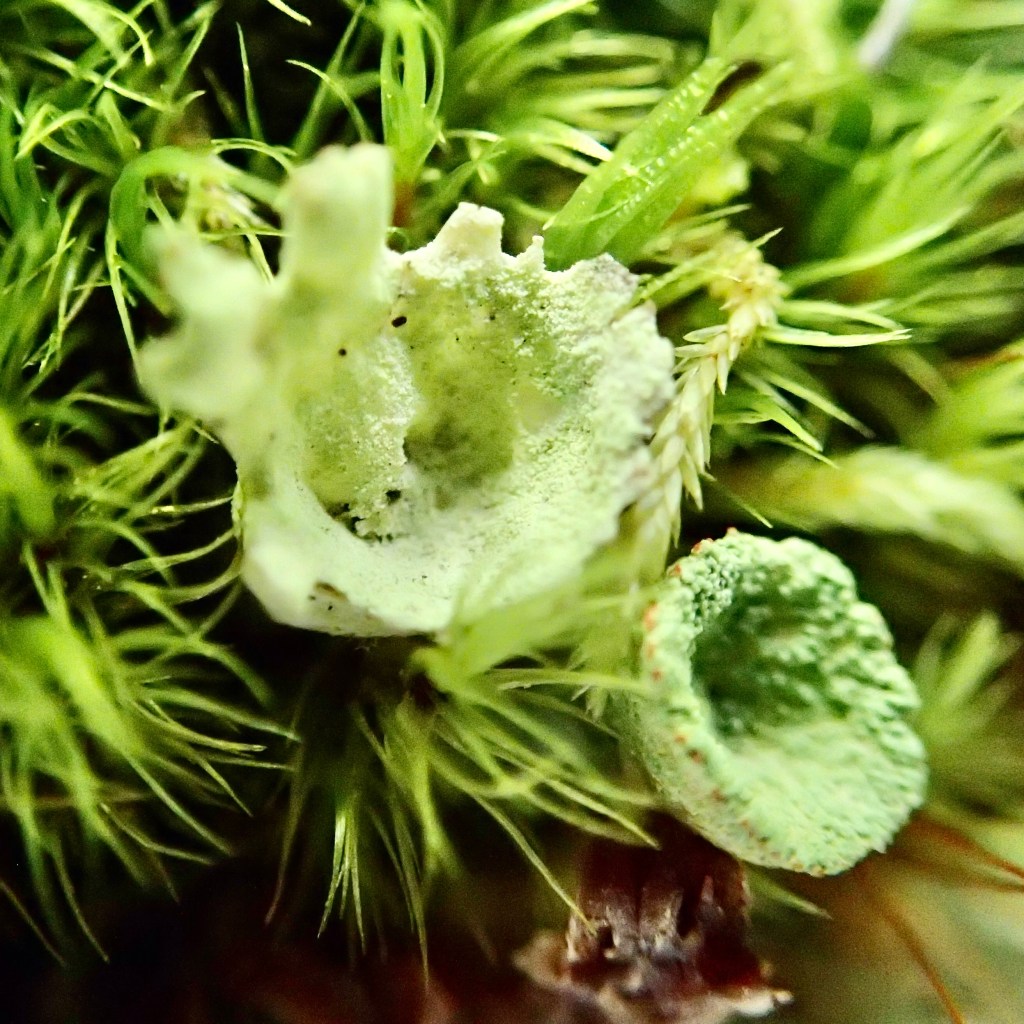
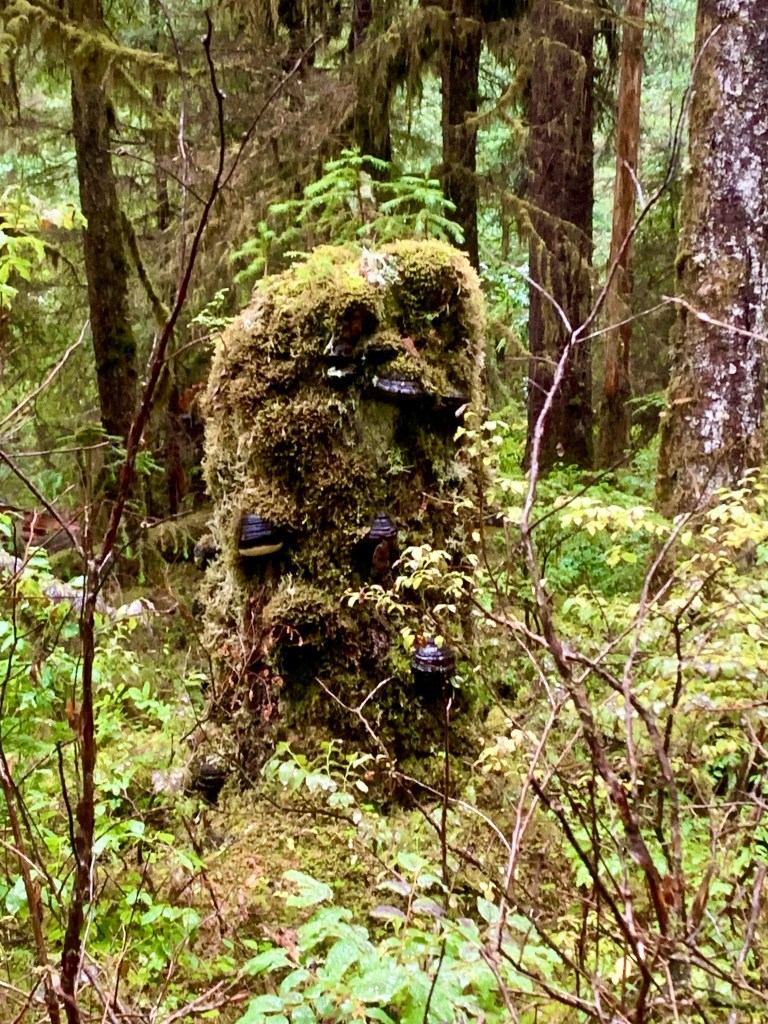
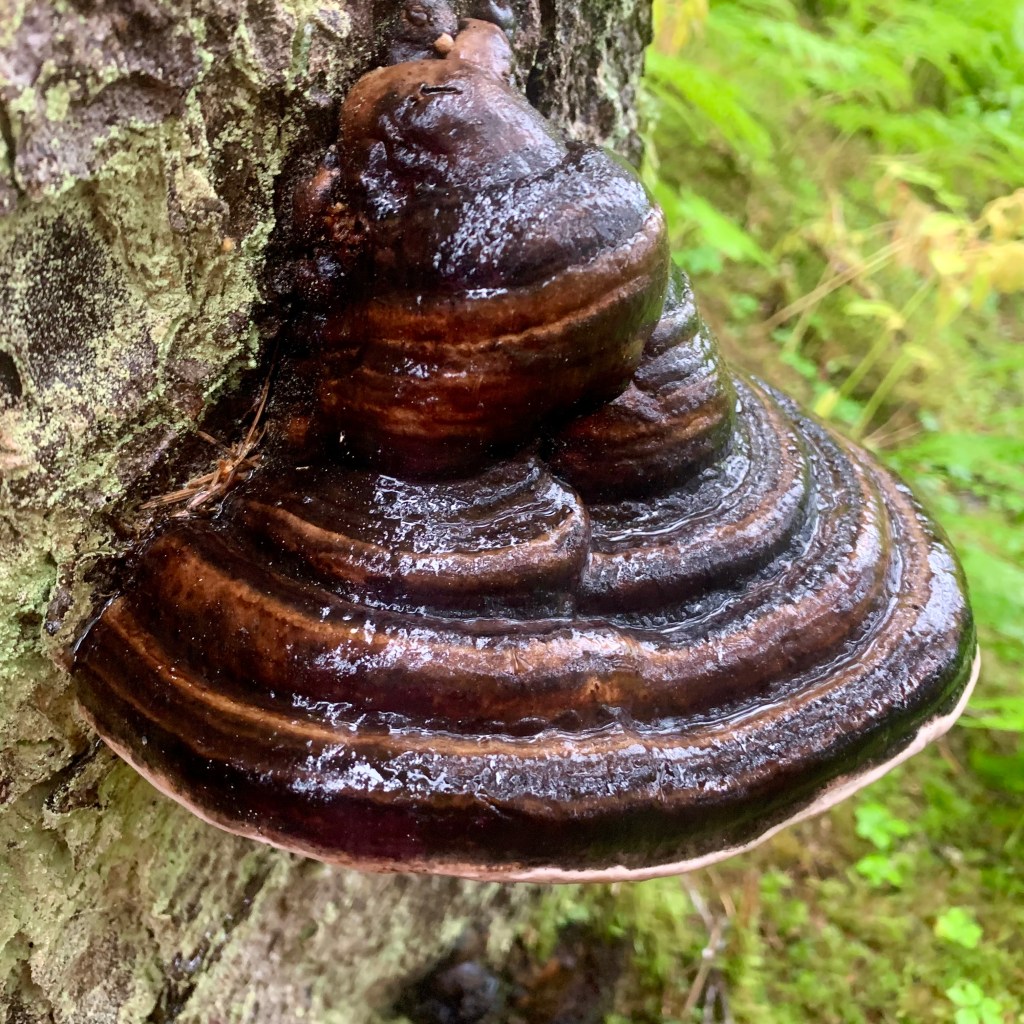
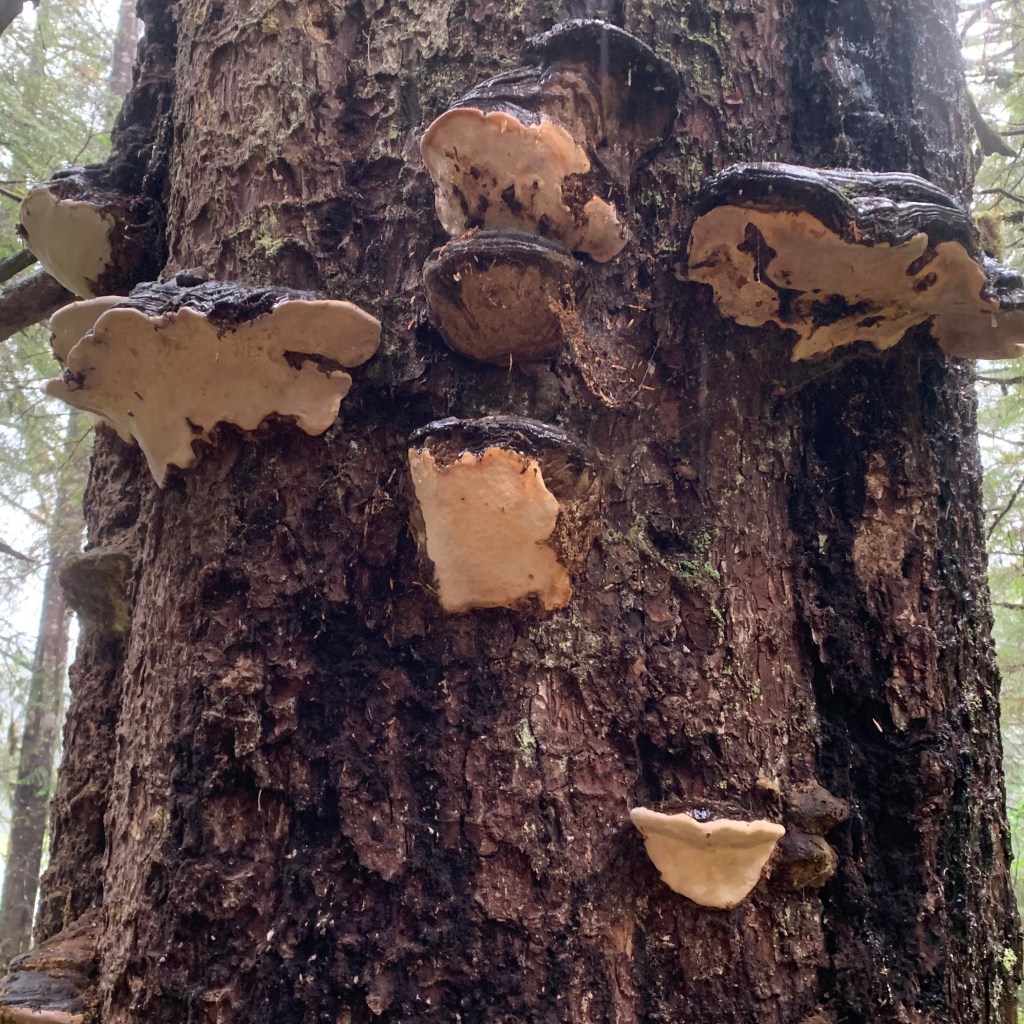
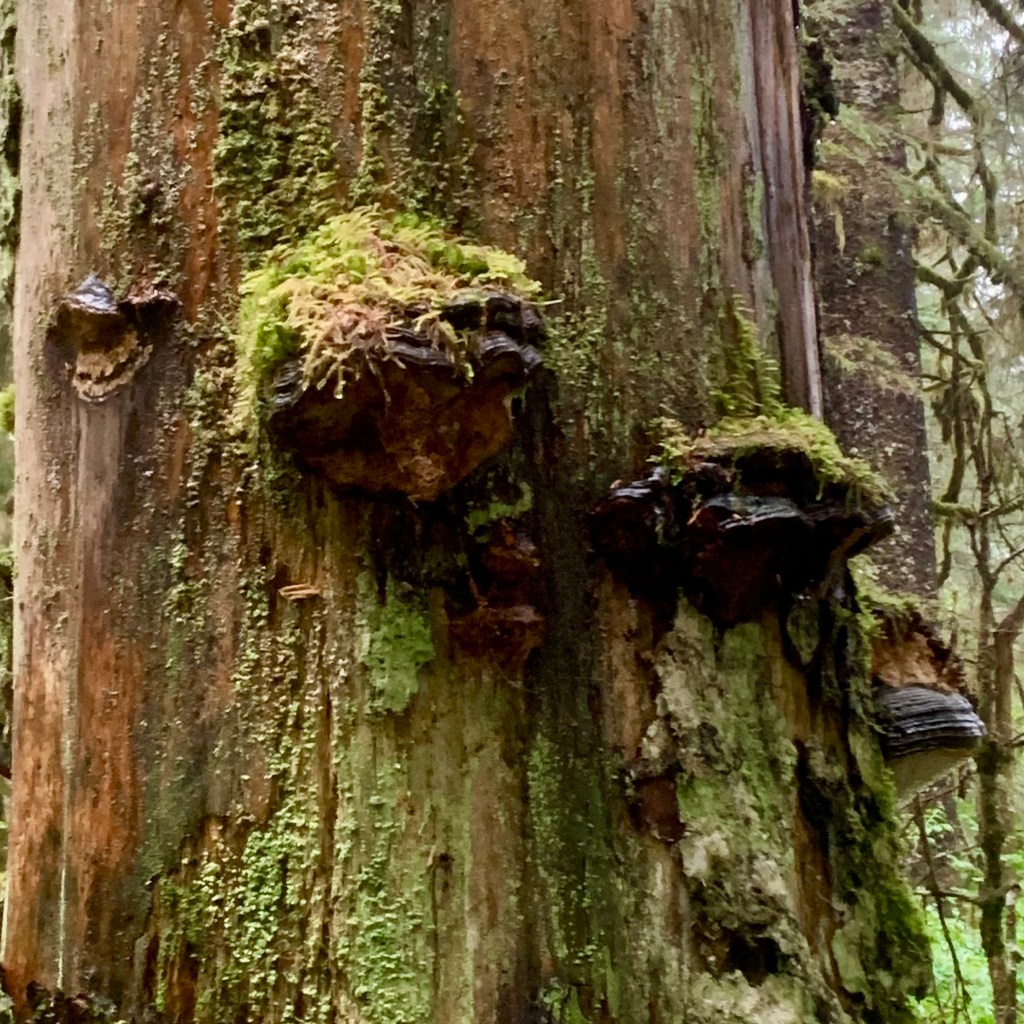
They were hard to ignore and I was fascinated by the conks which are  shelf-like fungal growths of artistic beauty on trees (aka shelf fungi or bracket fungi) and are  members of the fungus kingdom which includes mushrooms, molds, and yeast. Unlike mushrooms, most conks are inedible because they are tough and corky or woody. They can be seen growing on tree trunks and limbs, stumps, fallen logs  and are important recyclers in forest ecosystems in the process of decomposing woody material.  Some were “hatless” and others wore cloches of moss and lichen. Cloaks of lichens also were draped over many other surfaces and varied from bright green to olive drab. 

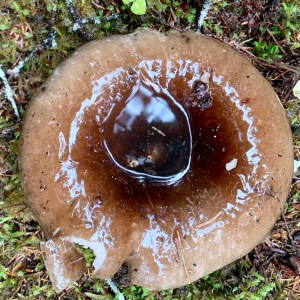
Mushrooms have a captivating appearance. I wonder what these open parasols were sheltering whatever creatures might be hunkering down to wait out the drizzle. Other s were inverted parasols catching the raindrops creating a shimmering pool. They could be seen dotting the rain swollen floor with a diversity of shapes size and colors and hues.

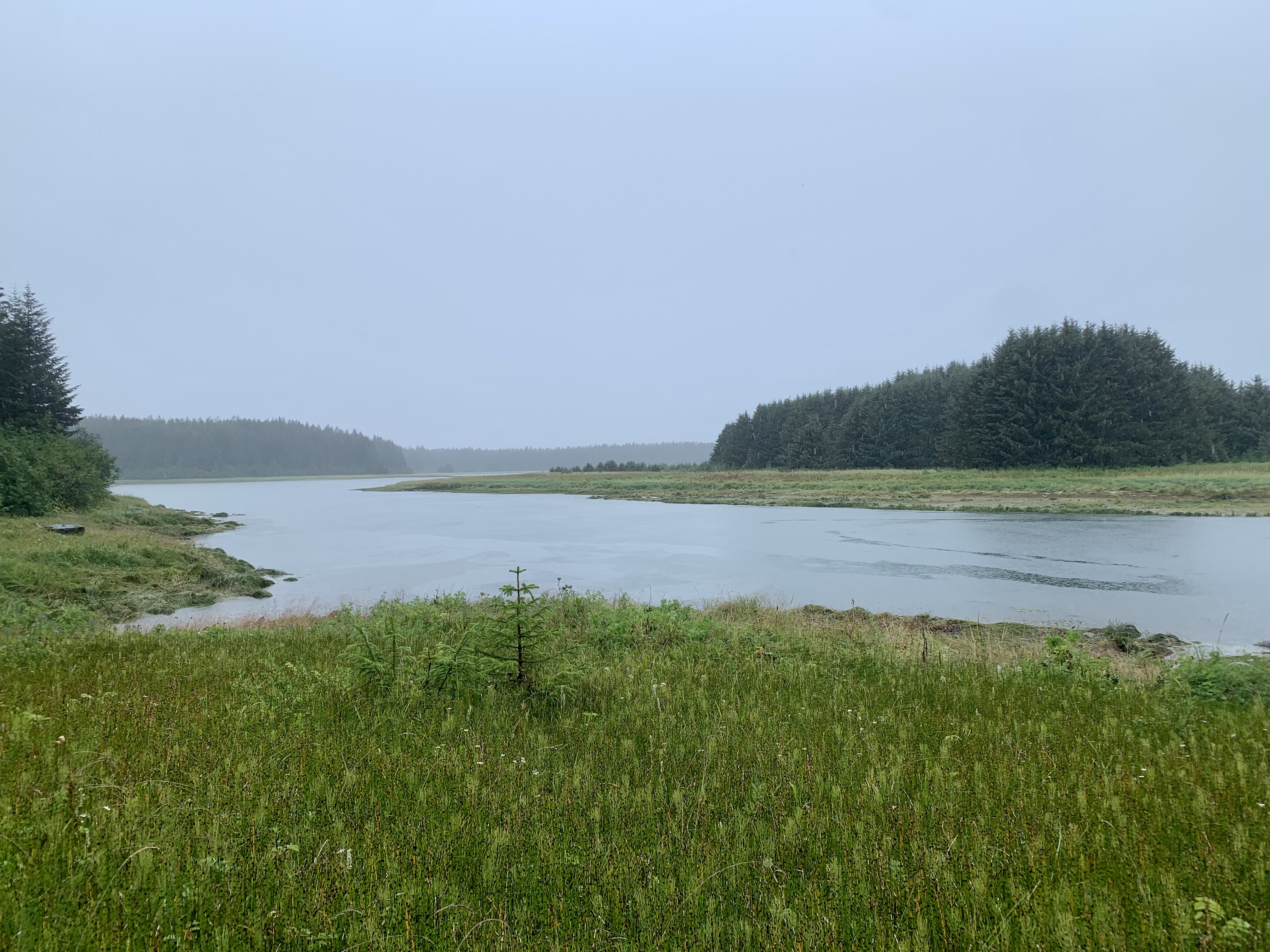
The shimmering veil of rain continued when this forest trail ended at an estuary near the mouth of the Bartlett River.  I made the executive decision to stop here as I could already tell that I would be mired in deep mud should I have proceed a few hundred feet more to the actual mouth of the river. Wet is one thing but mud oozing into my shoes was not a necessary part of this rain forest experience. So it was time to plunk down on a large lichen covered boulder , with much of my “carefully wrapped” body draped in sodden attire and attempt to enjoy a lunch which was also getting quite sodden as I tried transporting the food to my mouth. The most successful piece of attire I had chosen was my visor in keeping the rain off my face. Water had dripped down into the arms of the raincoat every time I went to take a photo. My whole backside by now felt wet as I discovered that those ancient rain pants had split open.

Hiking out I plodded along with the drumbeat of the rain on the forest canopy and understory. The steady beat would have been totally mesmerizing had I not been quite aware that I was wobbling a bit like a Weeble and did not want to fall down. My legs were tired so I tried focusing on this living cathedral of towering trees, on the the diverse tapestry of the forest floor, and assessing the deeping puddles obscuring the obstacles ahead. In this type of immersion other folks have talked of a spiritual experience or a sacred moment in a lush and fecund forest, this waterfall from heaven. With the air solidly full of water, I was picturing fish swimming in the tree tops, hearing a torrential cacophony, and thinking about a hot shower back at the Lodge.

Upon my return, having had natures bath, I immediately climbed into the bathtub to strip out of my saturated clothes, stuffed them into a plastic bag, took a delicious hot shower , and then headed out to the “public laundromat” next to the lodge. I did not savvy either putting on these soppy clothes tomorrow should I need them or filling my suitcase with dripping, waterlogged apparel. This” laundromat” was not what I had expected but I did end up with dry gear. Now for a pricy well earned dinner in the Lodge, my mouth agape as I peered out the window of the dining room at blue skies!